

An SBC gives a prototype ready-to-use connectors. A system-on-module lets a team design the carrier around its own enclosure and interfaces. The decision depends on whether that customization is worth the additional electrical, mechanical and production work.
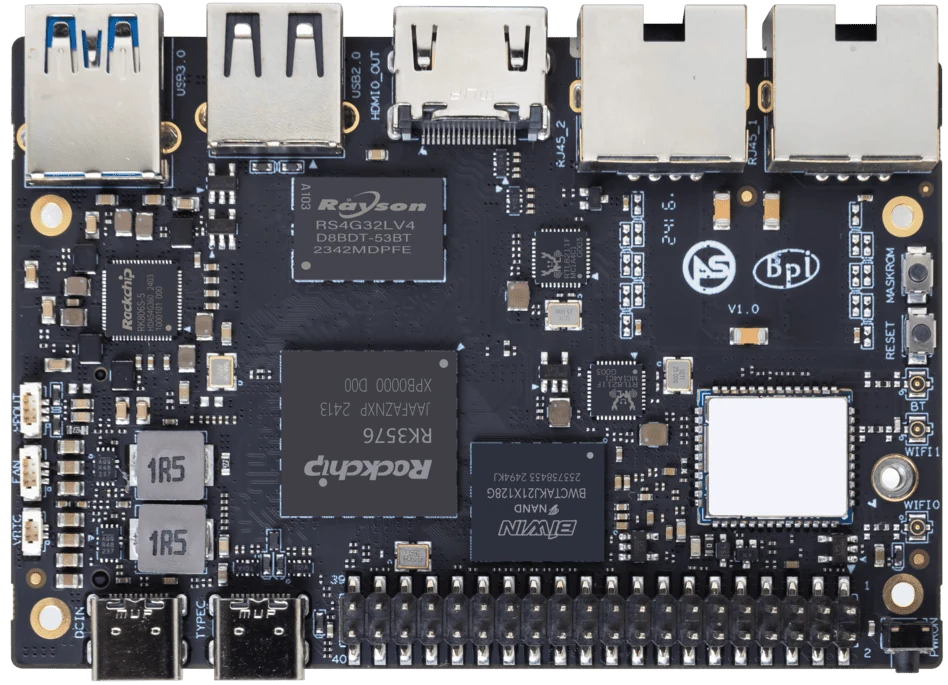
ArmSoM Sige5
Count the interfaces the product actually uses
If the product can use an SBC’s existing connectors and shape, a custom carrier may add little value. If it needs a different enclosure, connector placement or power arrangement, a module can make sense. Include carrier design, assembly, test fixtures and software maintenance in the decision alongside the module price.
A module moves responsibility to the carrier
CM5 and CM7s allow the product designer to choose the carrier layout and exposed interfaces. That also creates work: power regulation, signal integrity, connector protection, assembly, compliance and manufacturing tests. Compare the entire engineering programme, not only module cost. An SBC can remain the right production choice at modest volumes if it meets the mechanical and operational requirements.
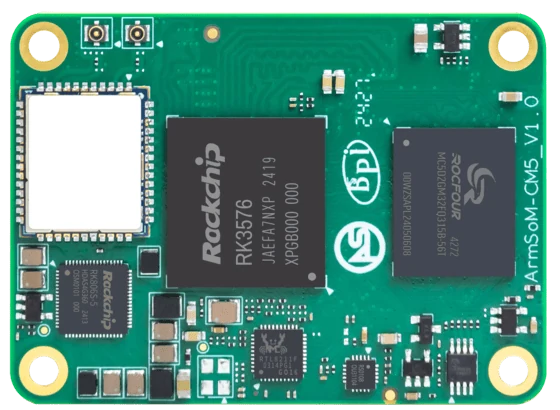
ArmSoM CM5
Match the choice to your requirements
Requirement or situation | What to evaluate | Decision detail |
Fast proof of concept | SBC | Use existing connectors and supported images. |
Custom physical interfaces | SoM plus carrier | Budget carrier development and validation. |
Field replacement | Either, with a plan | Design access, spare images and service procedures. |
Example design
Choose the smallest amount of custom work that solves the problem
If the device needs standard connectors and fits an existing enclosure, an SBC can shorten integration. If connector position, size or a custom electrical interface is fundamental, a module and carrier may be justified. Compare the complete assemblies, including regulators, connectors, shielding, mounting and testing. The module’s smaller outline alone does not prove that the final product will be smaller or cheaper.
Compare total cost with a simple model
Compare the cost to ship and support a working product, not just board prices. For an SBC approach, include the board, adapters, enclosure changes, assembly and integration software. For a SOM approach, include the module, carrier, engineering, tooling, bring-up and test fixtures.
A useful planning equation is: total project cost equals fixed engineering and setup cost plus quantity multiplied by per-unit delivered cost. If a custom design has a higher fixed cost but a lower per-unit cost, the difference can be compared at several realistic production quantities.
Do not treat the resulting break-even point as a promise. Revision cycles, component availability, yield and support effort can change the inputs. Use supplier quotations and your own engineering estimates, then update the model after the first prototype.
Protect the transition between prototype and product
If you expect to move to a module, prototype on the same processor family where practical. Also test the peripherals that will remain in the final device. Moving from a USB camera prototype to a custom MIPI camera later introduces a separate integration task.
Keep application logic separate from board configuration. Put GPIO assignments, device paths and hardware-specific initialization in a small, documented layer. Store device-tree changes and image build settings alongside the hardware revision they describe.
Freeze the carrier only after the highest-risk interfaces have been demonstrated. A display or camera that has not yet worked is a design dependency, not a minor software detail to close after PCB manufacturing.
Additional references
Hardware and documentation
CM5 · RK3576
RK3576 module, 6 TOPS NPU, 55 × 40 mm and two 100-pin connectors. Module supply: 4 V recommended, 5.5 V maximum. The planned v2.0 memory option is LPDDR4/4x; current availability must be confirmed.
Hardware documentation · Product details
Sige5 · RK3576
RK3576, four Cortex-A72 and four Cortex-A53 cores, 6 TOPS NPU, dual Gigabit Ethernet and M.2 PCIe 2.1 x1.
Hardware documentation · Product details
CM7s · RK3588S
RK3588S, 6 TOPS NPU, 55 × 40 mm and three 100-pin connectors. ArmSoM offers CM7s as an Orange Pi CM5 replacement option; confirm the exact carrier, revision and software combination.
Hardware documentation · Product details
Sige7s · RK3588S
RK3588S, 6 TOPS NPU, Gigabit Ethernet and removable eMMC. Dimensions: 85 × 56 × 17 mm. Disconnect power before replacing eMMC.
Hardware documentation · Product details
Frequently asked questions
Is a SoM always better for production?
No. Production suitability depends on requirements, volume, maintenance and total engineering cost.
Product information and support
Sources
Written by ArmSoM using the documentation below. Example designs are proposals, not measured customer installations.