
ArmSoM CM5
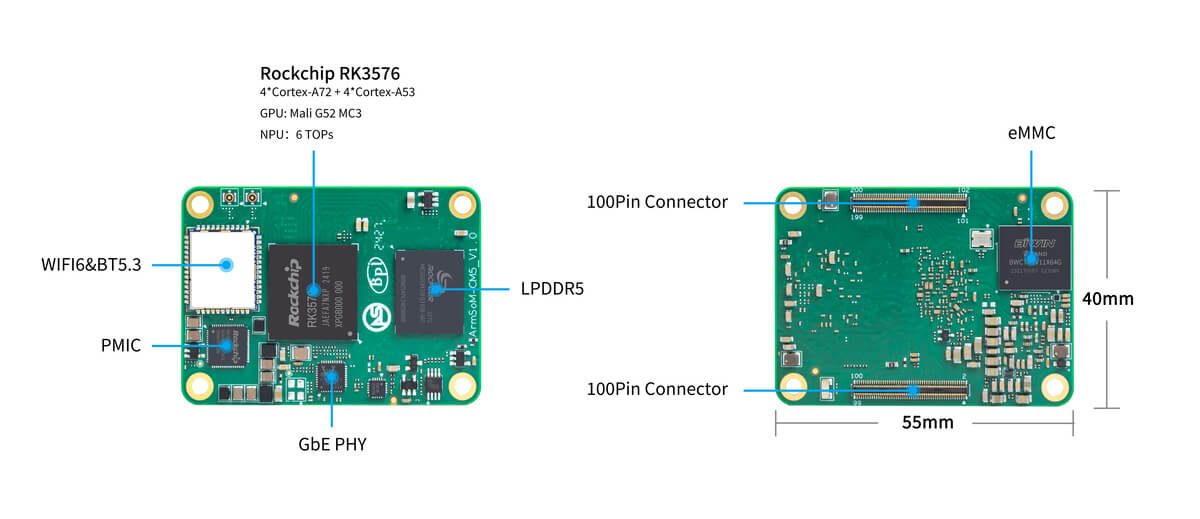
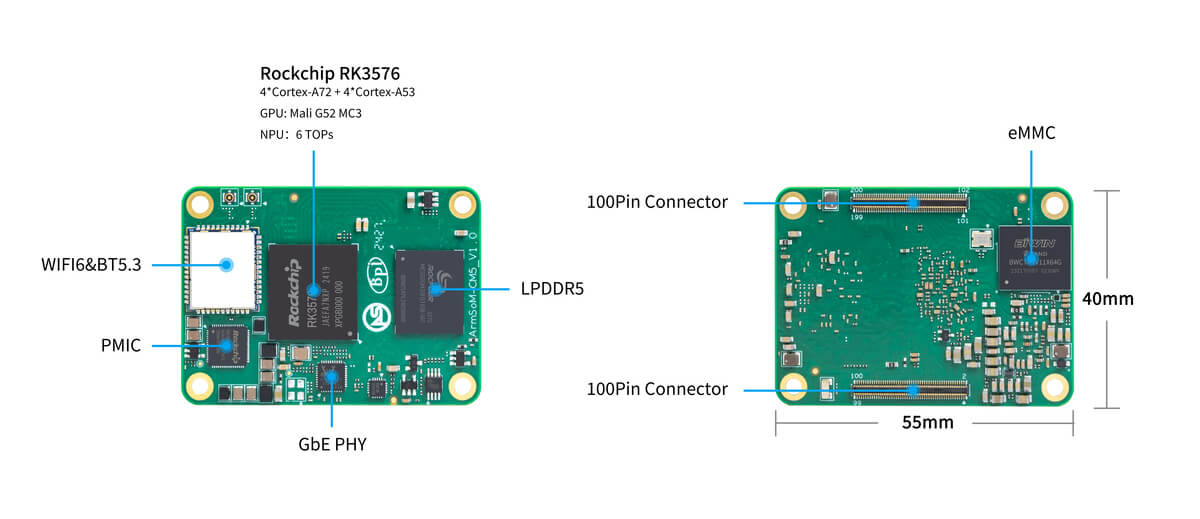
Powered by the Rockchip RK3576 (8nm AIoT platform): 8-core CPU, 6 TOPS NPU, up to 16GB LPDDR5, up to 4K@120fps video decoding and 4K@60fps video encoding, onboard WiFi 6 + BT 5.3, and a 55×40mm form factor compatible with Raspberry Pi CM4 carriers.
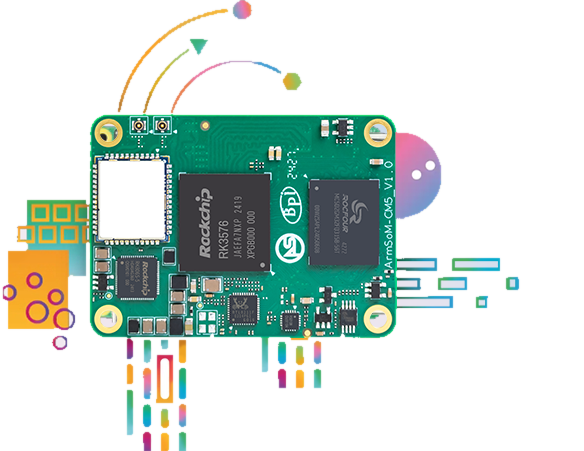
Six Core Features
Built on the Rockchip RK3576 second-generation 8nm AIoT platform and compatible with Raspberry Pi CM4 carriers, designed for embedded productization
8-Core 64-bit CPU
4× Cortex-A72 @ 2.2GHz + 4× Cortex-A53 @ 1.8GHz on an advanced 8nm process, with dedicated NEON coprocessors for strong multithreaded performance
6 TOPS NPU
A built-in AI accelerator supporting INT4/INT8/INT16/FP16/BF16/TF32 mixed-precision operations, ready to deploy mainstream models such as YOLO and ResNet
Mali-G52 MC3 GPU
Compatible with OpenGL ES 1.1/2.0/3.2, OpenCL 2.0 and Vulkan 1.1, plus a dedicated 2D hardware engine with MMU for smooth display performance
4K@120 Video Pipeline
Decoding supports H.264/H.265/VP9/AV1/AVS2 up to 8K@30fps or 4K@120fps (JPEG 4K@60fps); encoding supports H.264/H.265 and JPEG up to 4K@60fps
Up to 16GB Memory
32-bit LPDDR5 high-speed memory available in 2GB / 4GB / 8GB / 16GB (8GB default); onboard 32/64/128GB eMMC (64GB default), with MicroSD and M.2 M-KEY NVMe SSD expansion
We plan to introduce CM5 v2.0 with LPDDR4 memory to offer more flexibility as memory prices change.
CM4-Compatible B2B Module
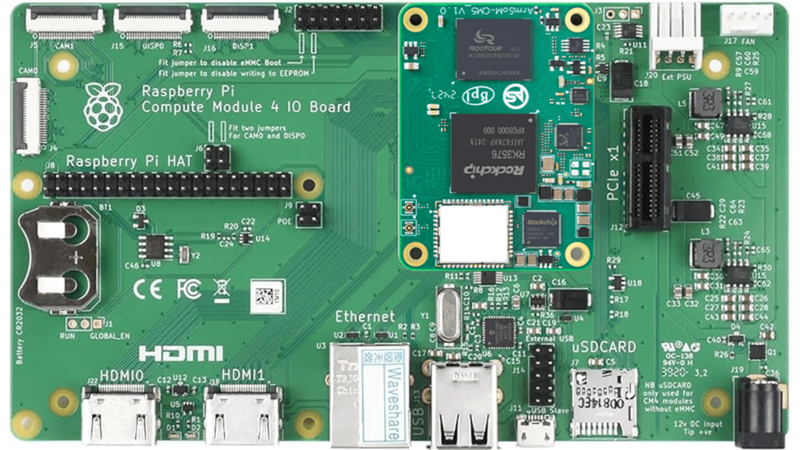
2×100-pin board-to-board (B2B) connectors in the same specification as Raspberry Pi CM4, so it plugs directly into the official Raspberry Pi CM4 IO Board; the compact 55×40mm size fits easily into industrial equipment and custom products
Product Gallery
A compact 55×40mm compute module integrating RK3576 SoC + LPDDR5 + eMMC + WiFi 6, ready for CM4 carriers or the official CM5-IO board
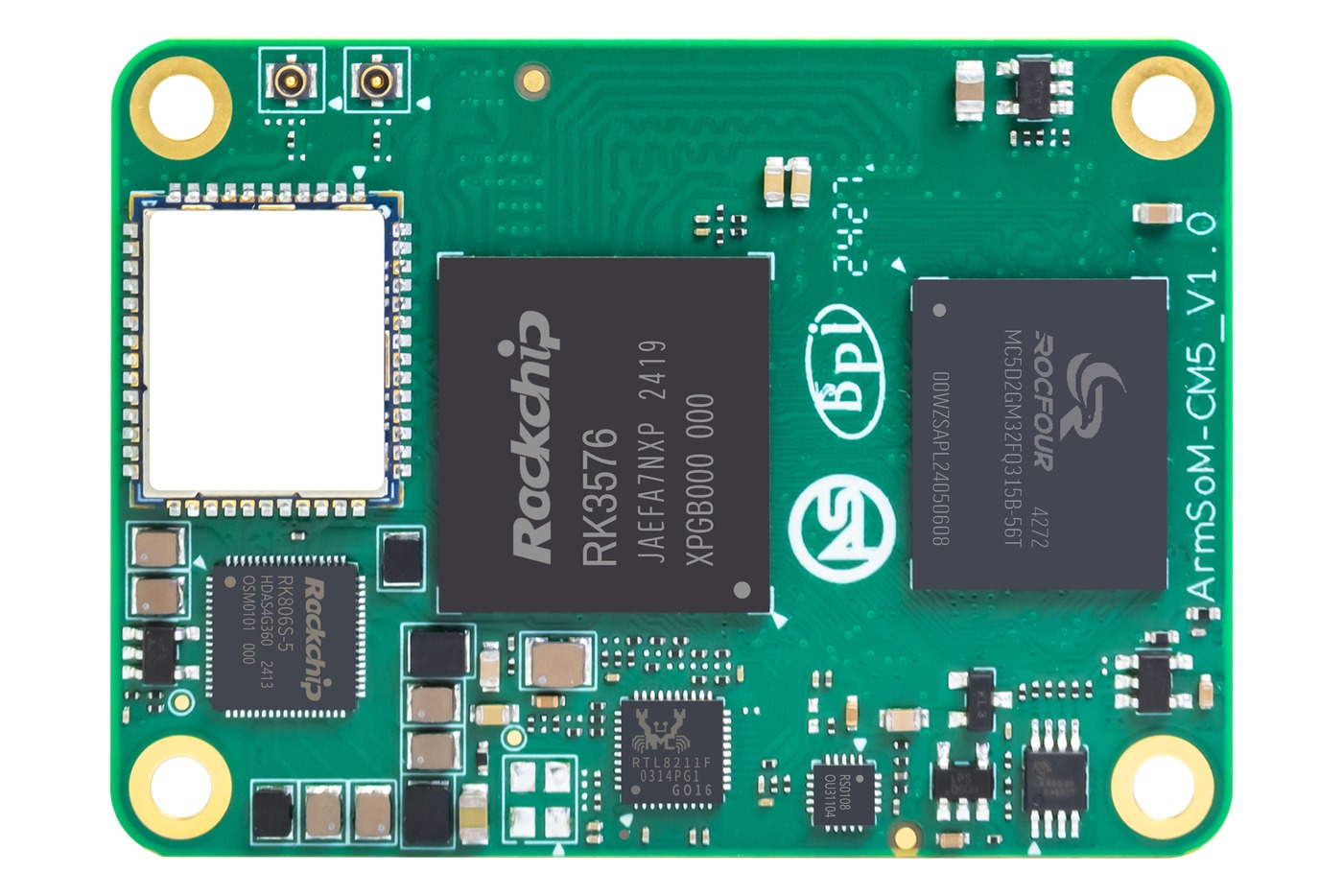
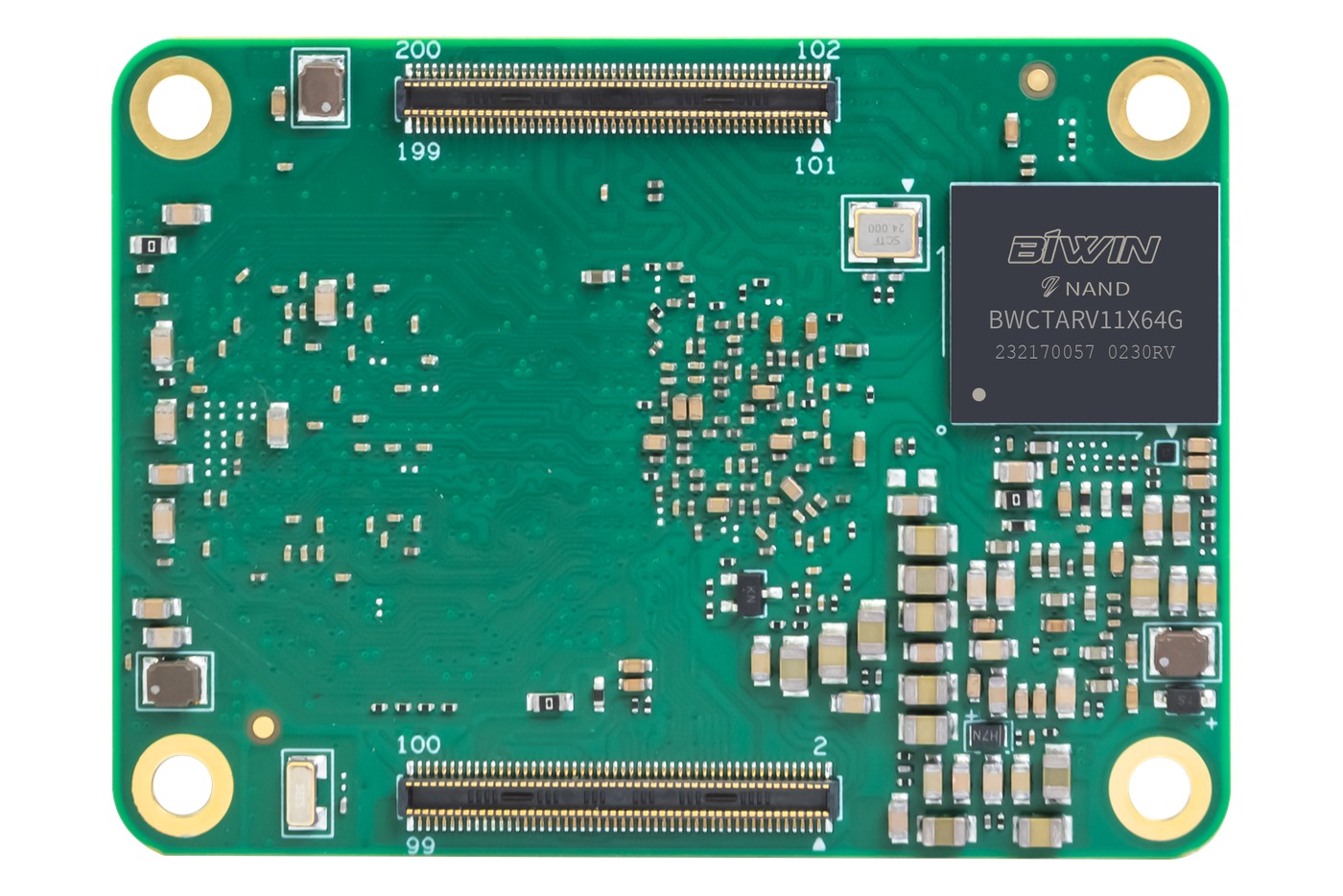
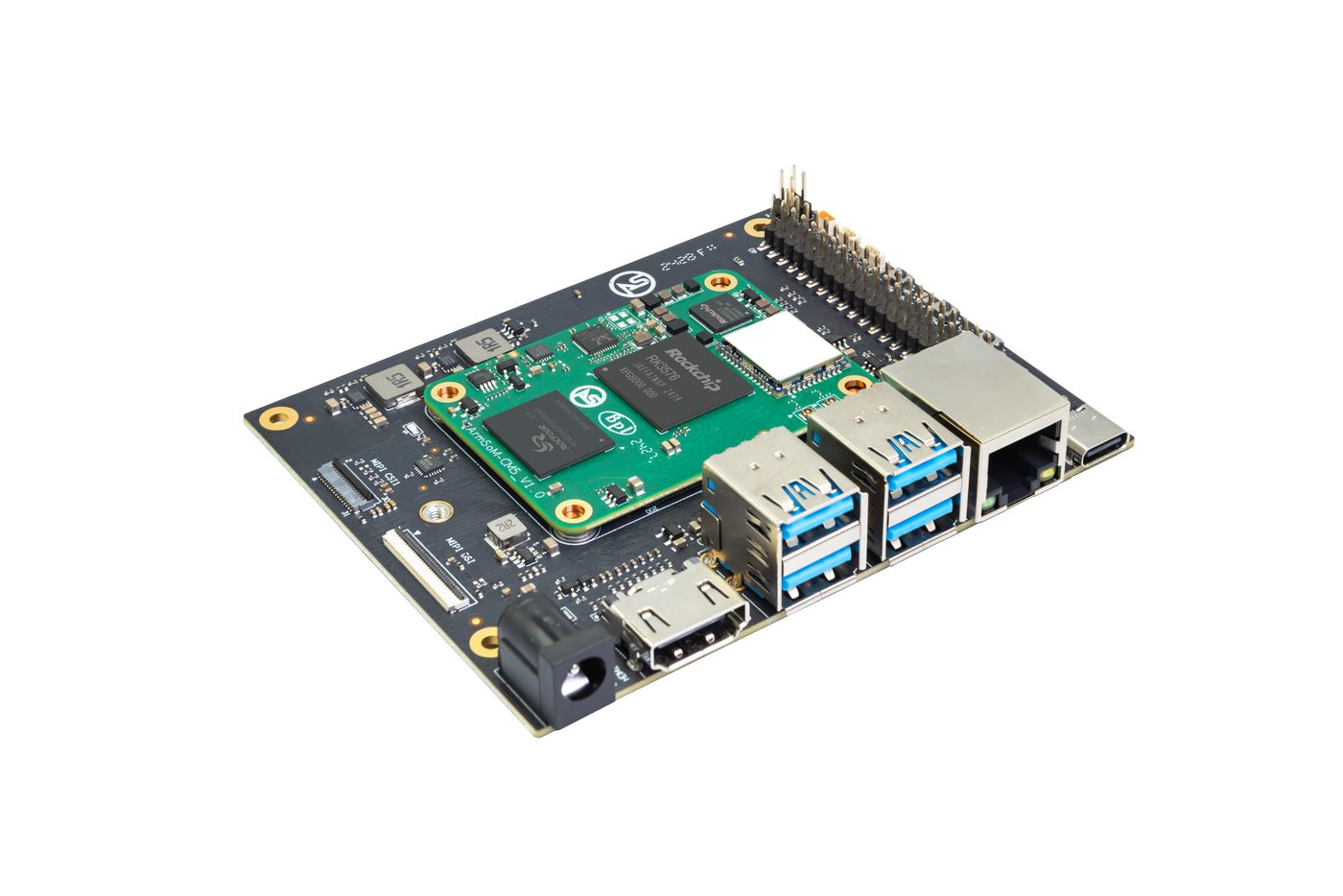
RK3576 — Second-Generation 8nm AIoT Platform
RK3576 combines an 8-core CPU, Mali-G52 MC3 GPU and 6 TOPS NPU, bringing RK3588-family architecture at a better price-performance ratio
ArmSoM CM5 vs Raspberry Pi CM4 at a Glance
CM5 and Raspberry Pi CM4 share the same 55×40mm footprint and board-to-board connector specification, so CM5 can use Raspberry Pi CM4 carriers directly; at the same time it upgrades the CPU architecture, NPU performance, memory capacity, video codec and high-speed expansion.
| Specification | Raspberry Pi CM4 | ArmSoM CM5 |
|---|---|---|
| SoC | Broadcom BCM2711 | Rockchip RK3576 |
| CPU | A72×4 | A72×4 + A53×4 |
| GPU | VideoCore VI | Mali-G52 MC3 |
| NPU | None | 6 TOPS |
| Memory | 1/2/4/8GB LPDDR4 | 2/4/8/16GB LPDDR5 |
| Storage | Optional 8/16/32GB eMMC (Lite has no eMMC) | 32/64/128GB eMMC |
| Video Decoding | H.265 up to 4Kp60 | H.265/AV1 8K@30 / 4K@120 |
| Display Output | 2× HDMI 2.0 | 1× HDMI 2.1 + 1× DP 1.4 |
| Camera | 1× 4-lane + 1× 2-lane CSI | 1× 4-lane + 1× 2-lane CSI |
| USB | 1× USB 2.0 | 1× USB 3.0 + 1× USB 2.0 |
| Expansion | 1× PCIe 2.0 | 2× PCIe 2.0 / USB 3.0 |
| Ethernet | 1× Gigabit | 1× Gigabit |
| GPIO | 40-PIN | 40-PIN |
| Dimensions | 55×40mm | 55×40mm |
| Operating System | Raspberry Pi OS / Ubuntu, etc. | Debian 12 / Android 14 / Ubuntu / Armbian |
| Availability | — | At least through August 2034 |
● Same as CM4, CM4 carrier reusable ● CM5 specification upgraded or differs
Performance Comparison
CM5 leads same-priced compute modules in AI performance, CPU performance and video codec
| Product | AI Accelerator | AI Performance | Notes |
|---|---|---|---|
| ArmSoM CM5 | Built-in NPU | 6 TOPS | Supports INT4/INT8/INT16 mixed operations |
| Raspberry Pi CM5 | No built-in NPU | — | CPU/GPU inference |
| Raspberry Pi CM4 | No built-in NPU | — | CPU/GPU inference |
AI Edge Inference
The 6 TOPS NPU supports mainstream deep learning frameworks — one solution from prototype to deployment
The built-in NPU supports INT4 / INT8 / INT16 mixed-precision operations with up to 6 TOPS
Multi-Display Output
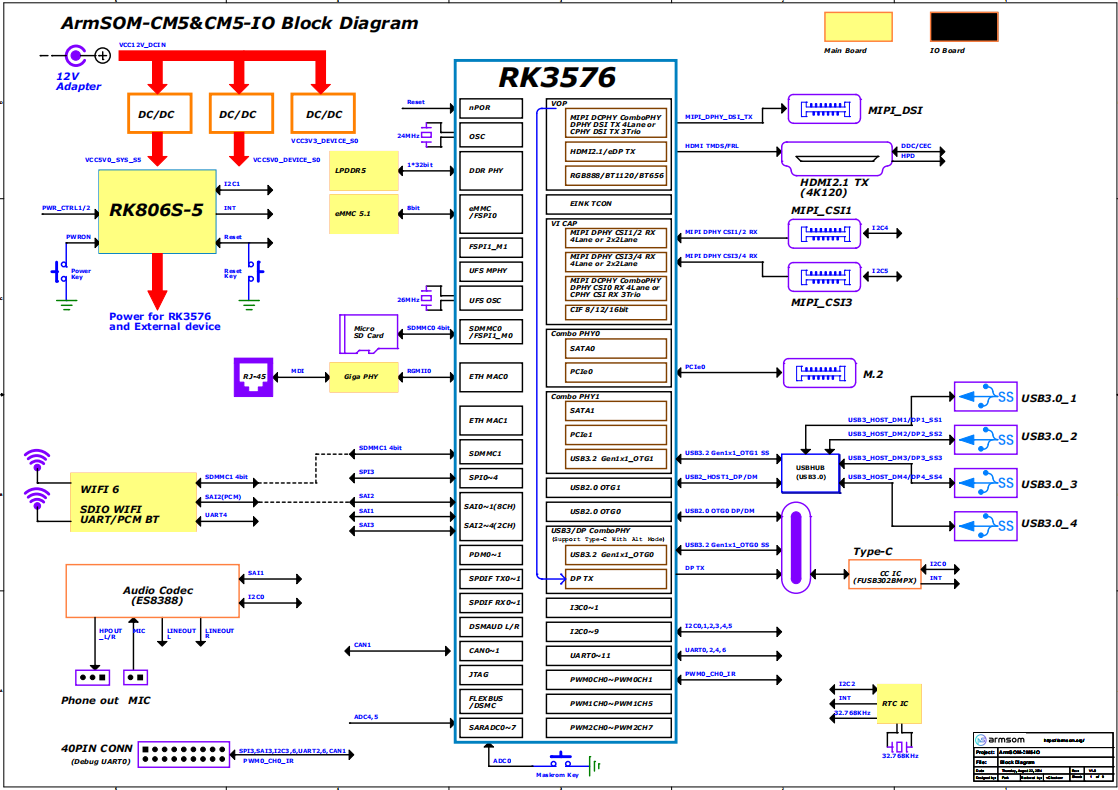
RK3576 supports independent HDMI, DP and MIPI DSI outputs for digital signage, HMI, multi-screen workstations and more
1× HDMI 2.1, 1× DP 1.4 and 1× MIPI DSI can drive multiple independent displays simultaneously, ideal for digital signage, HMI and multi-screen workstations
Rich Interfaces, Unlimited Expansion
All high-speed interfaces are routed through 2×100-pin board-to-board (B2B) connectors — the same specification as Raspberry Pi CM4, so existing CM4 carrier designs can be reused
Use Cases
From edge AI to industrial control, from digital signage to smart security, CM5 powers every industry
Technical Specifications
Complete hardware specifications for carrier board design and product integration
| Item | Specification |
|---|---|
| SoC | Rockchip RK3576, second-generation 8nm AIoT platform |
| CPU | 4× Cortex-A72 @ 2.2GHz + 4× Cortex-A53 @ 1.8GHz, with dedicated NEON coprocessors |
| GPU | ARM Mali-G52 MC3, compatible with OpenGL ES 1.1/2.0/3.2, OpenCL 2.0 and Vulkan 1.1, dedicated 2D hardware engine |
| NPU | 6 TOPS@INT8, supports INT4/INT8/INT16/FP16/BF16/TF32 mixed precision; supports TensorFlow / Caffe / TFLite / PyTorch / ONNX / Android NN |
| Memory | 32-bit LPDDR5, options 2GB / 4GB / 8GB / 16GB (8GB default) |
| Version Note | The current CM5 uses LPDDR5. We plan to introduce CM5 v2.0 with LPDDR4 memory to offer more flexibility as memory prices change. |
| Storage | Onboard eMMC 32GB / 64GB / 128GB (64GB default); MicroSD expansion supported; M.2 M-KEY supports PCIe 2.1 NVMe SSD |
| Video Decoding | H.264 / H.265 / VP9 / AV1 / AVS2 up to 8K@30fps or 4K@120fps; JPEG up to 4K@60fps |
| Video Encoding | H.264 / H.265 and JPEG up to 4K@60fps |
| ISP | 16MP ISP |
| Display Output | 1× HDMI OUT 2.1 (4K@120fps); 1× DP 1.4 (4K@120fps); 1× MIPI DSI (up to 2K@60fps) |
| Camera | 1× 4-lane MIPI CSI + 1× 2-lane MIPI CSI (up to 2.5Gbps per lane) |
| Network | 1× Gigabit GMAC (RGMII/RMII); onboard IEEE 802.11a/b/g/n/ac/ax WiFi 6 + BT 5.3 |
| USB | 1× USB 3.0 + 1× USB 2.0 |
| PCIe | 2× PCIe 2.0 1-lane |
| Audio | SPDIF_Tx ×1; AUDIO_R/L ×1; i2s ×1 |
| Other Interfaces | UART DEBUG ×1 / FAN ×1 / RTC ×1 |
| GPIO | 40-PIN (routed via carrier board) |
| Connector | 2×100-pin board-to-board (B2B) connectors, same specification as Raspberry Pi CM4, compatible with CM4 carriers |
| Dimensions / Weight | CM5: 55 mm × 40 mm × 4.9 mm, approx. 12g; CM5-IO carrier: 100 × 80 × 29 mm |
| Power Input | 4.5V ~ 5.5V |
| Operating Temperature | 0°C ~ 80°C |
| Operating System | Debian 12 / Android 14 / Ubuntu 22.04 / Armbian / ubuntu-rockchip |
| Availability | At least through August 2034 |
Compatible Ecosystem
Same footprint and connectors as Raspberry Pi CM4, so CM4 carriers work out of the box, and the official CM5-IO carrier lowers the barrier to development
Design Resources
Open hardware with complete design documentation, from schematics to SDK, to accelerate product development
Frequently Asked Questions
Ready to integrate CM5 into your product?
From sample orders to volume customization, ArmSoM provides end-to-end support
Or email us at sales@armsom.org