

An SBC suits Linux applications, networking and complex interfaces. A microcontroller can handle a smaller control task without the same operating-system overhead. Many products use both. Choose the division from timing, startup and maintenance requirements.
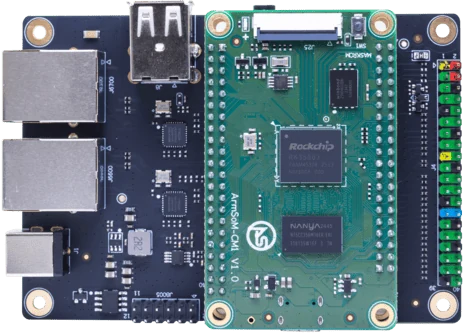
ArmSoM CM1-IO carrier and module. Carrier connectors and power input are distinct from the bare CM1 module.
Separate strict timing from application work
List response deadlines and what happens when they are missed. Keep those requirements distinct from dashboards, databases or remote updates. A Linux application can manage complex services, but a strict control loop needs an implementation whose timing has been measured. Adding another processor only helps when responsibilities and failure behavior are defined.
Design the communication contract
The host can send desired states or bounded commands while a controller checks limits and reports actual state. Include message version, sequence, timeout and error status. Decide what the controller does when commands stop arriving. Avoid an arrangement in which the last received command remains active indefinitely without a deliberate safety assessment.
Compare system complexity, not just chip count
Adding a controller introduces firmware, update and communication work, but can make responsibilities clearer. A simple data logger may not need that split. A connected actuator often benefits from it. Choose the architecture that can be tested and maintained by the team rather than assuming one powerful board should handle every function.
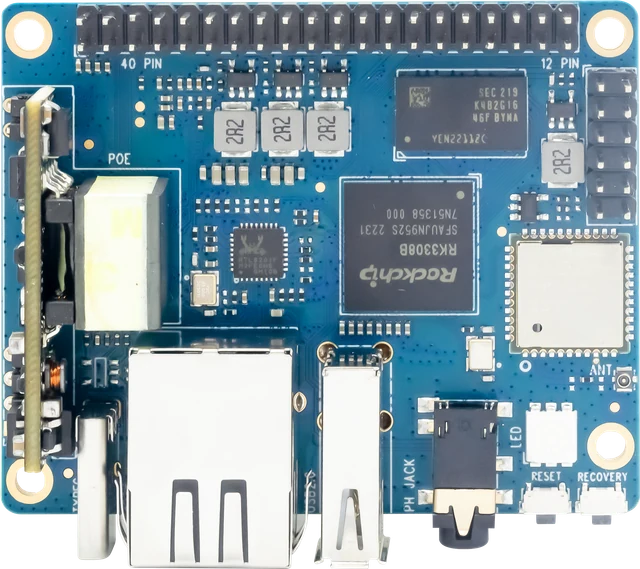
ArmSoM P2 Pro
Match the choice to your requirements
Requirement or situation | What to evaluate | Decision detail |
Linux platform | Network, UI, files and services | Plan updates and recovery. |
Microcontroller | Timing and peripheral supervision | Define bounded behavior. |
Connection | Commands and reported state | Detect stale or missing messages. |
Example design
Separate real-time control from the Linux application
A motor controller with strict timing requirements can need a dedicated control processor even when a Linux board provides networking and a user interface. Decide how commands, limits and status cross the boundary. A faster application CPU does not establish bounded response time. Test the system when the Linux side is busy, rebooting or disconnected from the controller.
Hardware and documentation
CM1 · RK3506J
RK3506J with three Cortex-A7 cores, a Cortex-M0 and 256 MB / 512 MB DDR3L options. The 5 V module supply differs from the CM1-IO carrier’s 12 V input.
Hardware documentation · Product details
Forge1 · RK3506J
RK3506J development board with 512 MB DDR3L, NAND storage and dual 100 Mbps Ethernet. Check the complete interface circuit before field wiring.
Hardware documentation · Product details
P2 Pro · RK3308B-S
RK3308B-S, 256 MB / 512 MB DDR3, 100 Mbps Ethernet, PDM and I2S audio. Board size: 65 × 52.5 mm. Storage and power accessories depend on the ordered configuration.
Hardware documentation · Product details
Frequently asked questions
Does this architecture make a device safety-certified?
No. Safety certification requires an appropriate system design and evidence beyond this division of work.
Product information and support
Sources
Written by ArmSoM using the documentation below. Example designs are proposals, not measured customer installations.