

An industrial Raspberry Pi alternative should be chosen from the equipment interfaces and operating conditions. A faster processor does not supply isolation, field wiring or a maintenance plan. ArmSoM boards and modules need evaluation as parts of the complete control system.
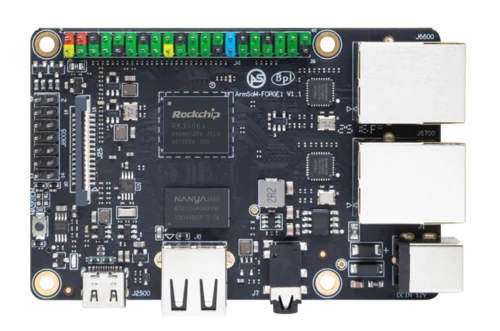
ArmSoM Forge1
Start at the field connection
Record the required electrical interface, connector, isolation and protection for each device. Distinguish a processor’s UART or CAN controller from a complete field-ready connection. Review the carrier or board circuitry and the enclosure conditions. Ask for product-specific evidence where temperature, certification or lifecycle requirements apply.
Choose a board or module deliberately
Forge1 provides an RK3506J board approach with dual 100 Mbps Ethernet and documented industrial expansion signals. CM1 uses the same processor family in a module-and-carrier approach; the additional Ethernet and wireless connections described for CM1-IO belong to the carrier. Sige3 offers a different RK3568B2 application platform. Match processing, storage and integration effort before comparing purchase price.
Ask for evidence of operational suitability
Test restart after supply interruption, service recovery, storage exhaustion and loss of network. Obtain applicable temperature, compliance and supply information for the exact product rather than borrowing a chip rating or another board’s certification. A well-documented recovery path can matter more to an unattended gateway than a higher benchmark score.
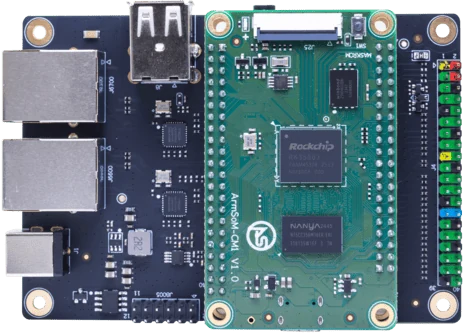
ArmSoM CM1-IO carrier and module. Carrier connectors and power input are distinct from the bare CM1 module.
Match the choice to your requirements
Requirement or situation | What to evaluate | Decision detail |
CM1 + carrier | Customized connections and enclosure | Include carrier engineering and module power requirements. |
Forge1 | Compact control-oriented board | Verify exposed transceivers and supported Linux image. |
Sige3 | More application and networking requirements | Validate the complete software and I/O workload. |
Example design
Choose an industrial platform from the field connections
A controller receiving machine signals may need isolated interfaces, protected power and a defined environmental range. An SBC with the right processor does not automatically include those properties. Draw the complete path from the field cable to the application and identify which elements the carrier or external module supplies. Evaluate documentation and maintainability alongside computing resources.
Hardware and documentation
CM1 · RK3506J
RK3506J with three Cortex-A7 cores, a Cortex-M0 and 256 MB / 512 MB DDR3L options. The 5 V module supply differs from the CM1-IO carrier’s 12 V input.
Hardware documentation · Product details
Forge1 · RK3506J
RK3506J development board with 512 MB DDR3L, NAND storage and dual 100 Mbps Ethernet. Check the complete interface circuit before field wiring.
Hardware documentation · Product details
Sige3 · RK3568B2
RK3568B2 with a 2.5GbE port and a separate Gigabit Ethernet port. Consult the revision-specific manual for expansion and boot support.
Hardware documentation · Product details
Frequently asked questions
Does industrial positioning mean a board is safety-certified?
No. Certification and safety claims require documents covering the actual product and application.
Product information and support
Sources
Written by ArmSoM using the documentation below. Example designs are proposals, not measured customer installations.