

A Modbus gateway has to handle both normal traffic and equipment that stops responding. The protocol choice, serial circuit and retry behavior affect reliability. An ArmSoM Linux board is the host; the field connection still needs its own design and testing.
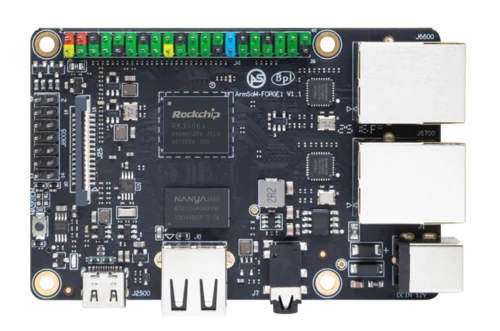
ArmSoM Forge1
Define the devices and polling schedule
Record whether each endpoint uses Modbus TCP or a serial arrangement, along with addressing and register definitions. Set timeouts and retries around the equipment’s documented behavior. Test disconnected and slow devices so one failed endpoint does not block every other poll. Log enough context to distinguish a protocol error from a broken physical link.
Use a read-only bench test first
Start with a simulator or approved device and only the permitted read operations. Verify timeouts, CRC handling where relevant, retries and behavior after disconnect. Avoid forwarding arbitrary write requests into a machine network. Define access controls and a small allowlist of operations when writes are genuinely required.
Measure freshness and recovery
Timestamp samples and expose stale-data status instead of quietly serving an old value as current. Test one missing device, slow responses and a full downstream queue. Confirm that restarting the gateway does not issue unintended writes. Record the board, transceiver, image, protocol library and test register map for reproducibility.
Match the choice to your requirements
Requirement or situation | What to evaluate | Decision detail |
Correctness | Known register values and byte order | Compare against device documentation. |
Failure | Timeout, disconnect and stale values | Surface explicit status. |
Operations | Access rules and restart behavior | Prevent unintended commands. |
Example design
Make gateway failures visible to the receiving system
A Modbus gateway should distinguish a valid zero reading from an unavailable device or timed-out request. Define register mapping, polling periods, exception handling and stale-data behavior before deployment. Test disconnection and reconnection while the upstream service remains active. The application must recover predictably without presenting old measurements as current, especially when multiple devices have different response times.
Hardware and documentation
Forge1 · RK3506J
RK3506J development board with 512 MB DDR3L, NAND storage and dual 100 Mbps Ethernet. Check the complete interface circuit before field wiring.
Hardware documentation · Product details
CM1 · RK3506J
RK3506J with three Cortex-A7 cores, a Cortex-M0 and 256 MB / 512 MB DDR3L options. The 5 V module supply differs from the CM1-IO carrier’s 12 V input.
Hardware documentation · Product details
Frequently asked questions
Does an RS-485 port mean Modbus works automatically?
No. The physical bus, protocol settings, register map and application behavior must all match.
Product information and support
Sources
Written by ArmSoM using the documentation below. Example designs are proposals, not measured customer installations.