

An MQTT gateway needs to reconnect and recover its application state when networking is unreliable. CPU demand may be modest, while buffering, credentials and storage become the harder parts. Test those behaviors on the intended ArmSoM image.
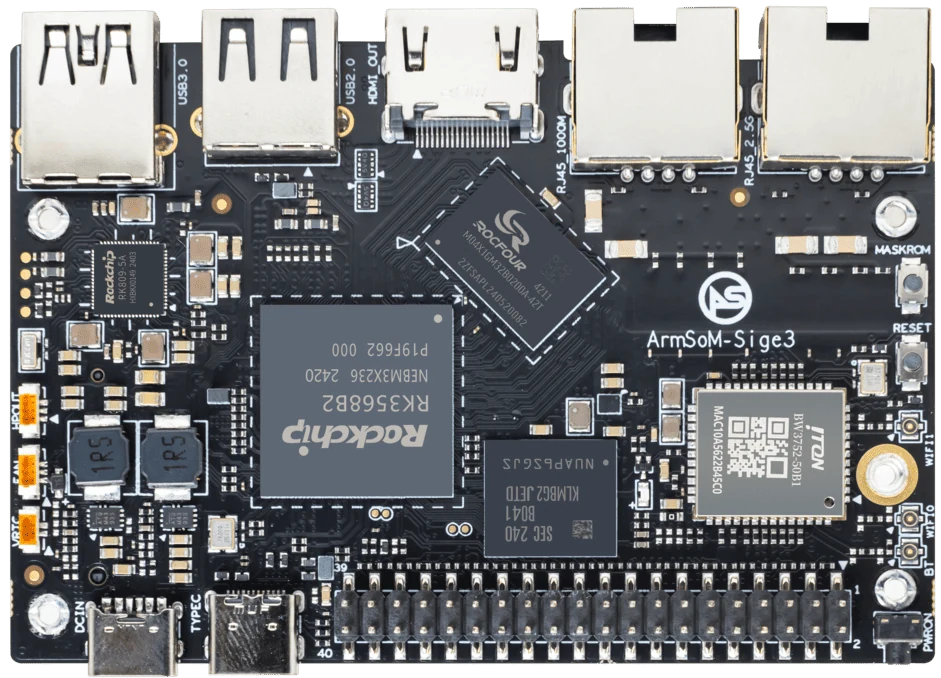
ArmSoM Sige3
Decide what happens to undelivered data
Choose which messages may be discarded and which need local persistence. Set a bounded queue and a policy for a full buffer. Test loss of the broker, restart of the gateway and restoration of connectivity. Record the selected delivery settings and how the receiving application handles duplicates.
Test duplicate and disconnected delivery
Applications must account for their selected MQTT delivery behavior. Check what happens after a network interruption, client restart and delayed message. Use timestamps or application identifiers where needed. Retained messages should not be mistaken for fresh sensor readings, and a reconnect should not trigger an unintended actuator action.
Move one function at a time
Bring up the target on a separate test namespace or broker. Compare payloads with the existing system, then verify buffering, disk growth and certificate renewal. Plan a reversible cutover so only the intended instance controls live outputs. Keep the previous system available until the new gateway has passed the agreed operational checks.
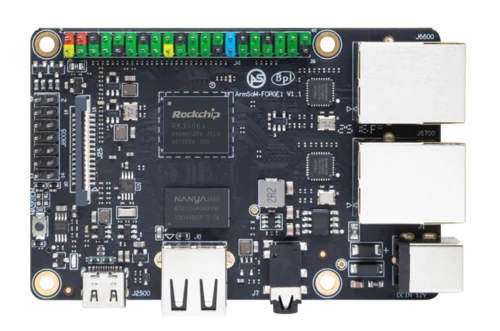
ArmSoM Forge1
Match the choice to your requirements
Requirement or situation | What to evaluate | Decision detail |
Compatibility | Libraries, architecture and hardware | Build on the target image. |
Semantics | Sessions, retained data and duplicates | Compare behavior explicitly. |
Cutover | Test namespace and rollback | Avoid two active control publishers. |
Example design
Plan what the MQTT gateway does while disconnected
Decide whether sensor messages are discarded, buffered or summarized during an outage. Document message expiry, identity and ordering expectations. Test reconnecting after the buffer is partly full, and check whether duplicates are handled correctly by the receiving application. Protocol delivery settings are useful tools, but they do not automatically provide exactly-once business processing across every system component.
Hardware and documentation
Sige3 · RK3568B2
RK3568B2 with a 2.5GbE port and a separate Gigabit Ethernet port. Consult the revision-specific manual for expansion and boot support.
Hardware documentation · Product details
Forge1 · RK3506J
RK3506J development board with 512 MB DDR3L, NAND storage and dual 100 Mbps Ethernet. Check the complete interface circuit before field wiring.
Hardware documentation · Product details
Frequently asked questions
Is changing the hostname enough for migration?
No. Credentials, state, dependencies and message behavior also need verification.
Product information and support
Sources
Written by ArmSoM using the documentation below. Example designs are proposals, not measured customer installations.