

Docker can carry an application’s userspace dependencies between boards, but it does not carry the host’s camera driver or device tree. A Raspberry Pi container still needs checking for CPU architecture, device access and hardware-specific libraries on ArmSoM.
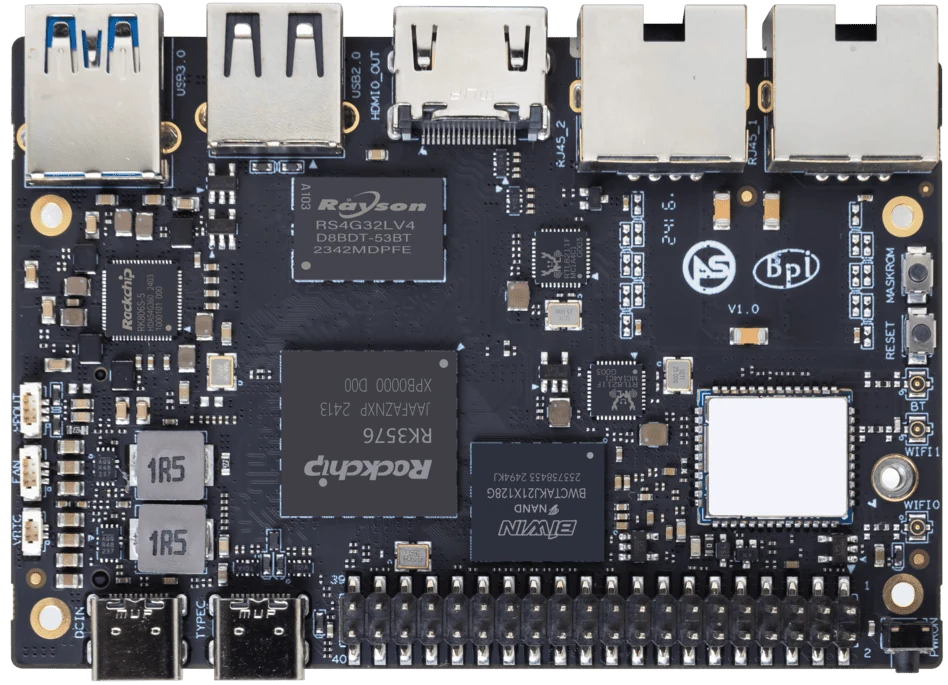
ArmSoM Sige5
Inspect the image architecture and device bindings
Check the container’s supported architecture and any bundled native libraries. List device mounts, network modes and permissions used on the original host. Start the service without hardware dependencies where possible, then add those bindings individually. The host kernel must expose a working device before a container can use it.
Move data separately from containers
Inventory volumes, bind mounts, environment configuration and secrets. Back up databases using their supported consistency procedure. Restore into a new test volume on Sige5 or Sige7, then compare application results. Never point a trial deployment at the only production database copy. Review filesystem ownership because numeric user IDs may differ.
Make hardware access explicit
Only pass through the devices the application needs. Validate their names and permissions after reboot. Camera, graphics and NPU dependencies must match the host runtime. Test restarts, network loss and storage-full behavior before moving the service endpoint. A working container process is not enough if its data is not persistent.
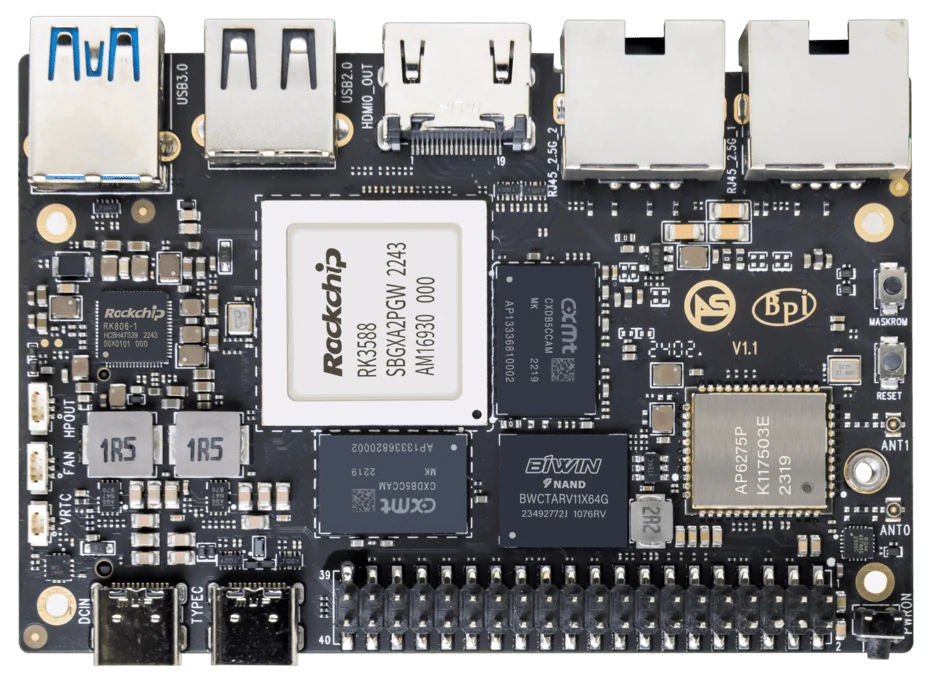
ArmSoM Sige7
Match the choice to your requirements
Requirement or situation | What to evaluate | Decision detail |
Image | Supported CPU architecture | Inspect before pulling a large stack. |
Data | Consistent backup and restore | Validate on a separate copy. |
Devices | Host driver and permissions | Test each acceleration path. |
Example design
Migrate a container without assuming hardware portability
A web service with a database can often be separated from its host more easily than a container accessing a camera or NPU. Verify the image architecture and native dependencies, then restore a copy of the data into a test instance. Hardware access remains dependent on the host kernel, device permissions and libraries. Keep the first migration isolated from the production database until read and write behavior is verified.
Hardware and documentation
Sige5 · RK3576
RK3576, four Cortex-A72 and four Cortex-A53 cores, 6 TOPS NPU, dual Gigabit Ethernet and M.2 PCIe 2.1 x1.
Hardware documentation · Product details
Sige7 · RK3588
RK3588, 6 TOPS NPU, dual 2.5GbE and M.2 PCIe 3.0 x4. Check the selected eMMC and wireless configuration.
Hardware documentation · Product details
Frequently asked questions
Does Docker make an x86-only application run natively on ARM?
No. It needs an appropriate build or a separate emulation strategy, which changes performance and support assumptions.
Can the same compose configuration be reused?
Often as a starting point, after checking architecture, paths, ports, devices and secrets.
Product information and support
Sources
Written by ArmSoM using the documentation below. Example designs are proposals, not measured customer installations.