

Sige5 and Sige7 offer different CPU, network and storage arrangements around RK3576 and RK3588. Both list a 6 TOPS NPU. That shared number should not obscure the rest of the system when choosing a board for a connected AI application.
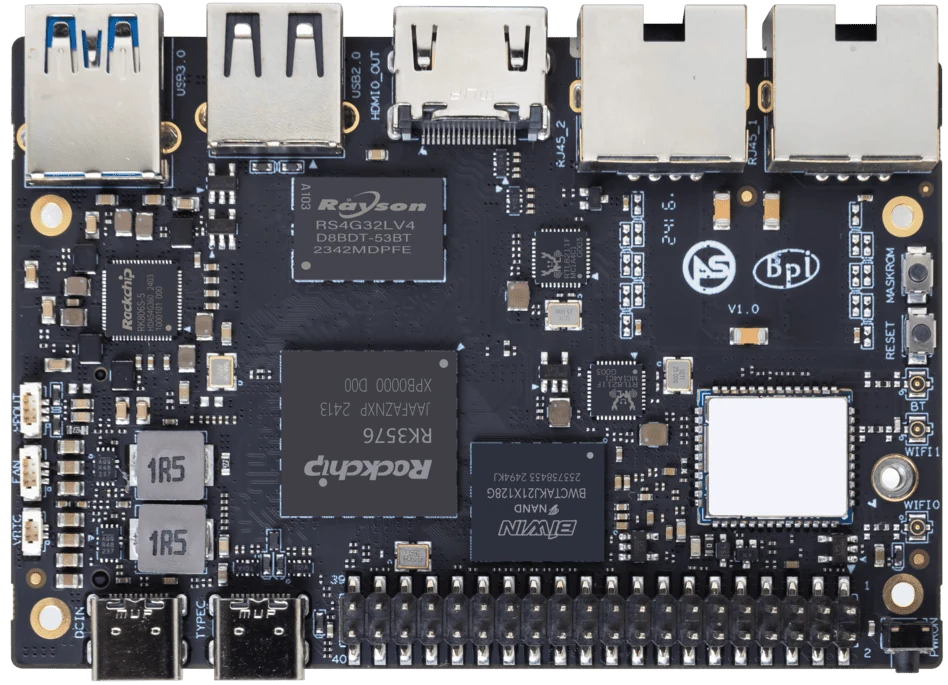
ArmSoM Sige5
Compare the application around the NPU
Record capture, preprocessing, storage and network demands as well as model inference. Sige5 lists dual Gigabit Ethernet and M.2 PCIe 2.1 x1; Sige7 lists dual 2.5GbE and M.2 PCIe 3.0 x4. Test those paths with the intended peripherals before treating their interface limits as application performance.
Make the software path explicit
Check the current image, kernel, graphics, camera and NPU requirements on each board. Historical mainline progress reports are valuable context, not a guarantee that every peripheral works in a current distribution. If an application relies on a vendor media stack, include that dependency in the selection record.
Budget the entire installation
Include storage, power, cooling, enclosure, cables and engineering work. If gigabit networking and the Sige5 storage path meet the requirement, paying for unused connectivity may add little value. If the workload needs Sige7’s particular I/O arrangement, an adapter-heavy alternative may create more integration work. Test the same application and report both strengths and limitations.
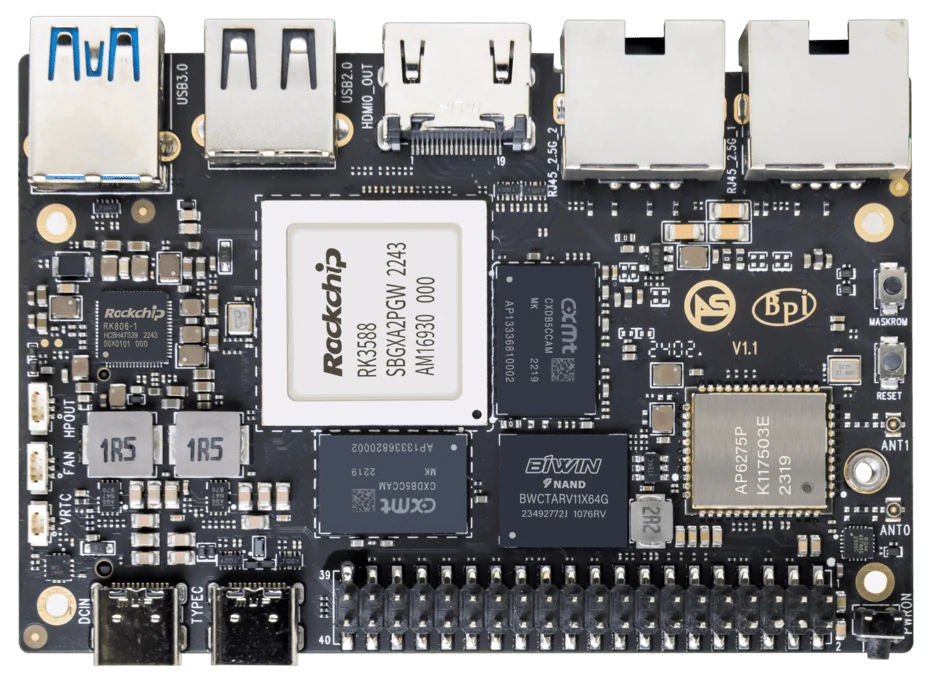
ArmSoM Sige7
Match the choice to your requirements
Requirement or situation | What to evaluate | Decision detail |
Sige5 | RK3576; dual GbE; M.2 PCIe 2.1 x1 | Evaluate for its actual application and software fit. |
Sige7 | RK3588; dual 2.5GbE; M.2 PCIe 3.0 x4 | Evaluate storage and network needs. |
Both | Documented 6 TOPS NPU class | Measure the converted model and full pipeline. |
Example design
Match the platform to the sustained workload
A networked application with local inference and moderate storage traffic can have different priorities from a multi-stream media server. Compare Sige5 and Sige7 using the required application, memory configuration and peripherals. Measure the workload under the intended cooling arrangement. A higher-tier processor is valuable when it removes a demonstrated bottleneck, not simply because its model number is larger.
Hardware and documentation
Sige5 · RK3576
RK3576, four Cortex-A72 and four Cortex-A53 cores, 6 TOPS NPU, dual Gigabit Ethernet and M.2 PCIe 2.1 x1.
Hardware documentation · Product details
Sige7 · RK3588
RK3588, 6 TOPS NPU, dual 2.5GbE and M.2 PCIe 3.0 x4. Check the selected eMMC and wireless configuration.
Hardware documentation · Product details
Frequently asked questions
Is RK3576 always slower in every task?
A universal claim would be misleading. Compare the specific workload, software and board configuration.
Product information and support
Sources
Written by ArmSoM using the documentation below. Example designs are proposals, not measured customer installations.
Rockchip RKNN Toolkit2: supported platforms and deployment tools
ArmSoM Sige5 mainline progress report (2024 historical record)