

Two Ethernet ports can simplify an appliance with separate equipment and upstream networks. Sige7, Sige5 and Sige3 offer different documented port arrangements. The right choice depends on what passes between those networks and what the application does with it.
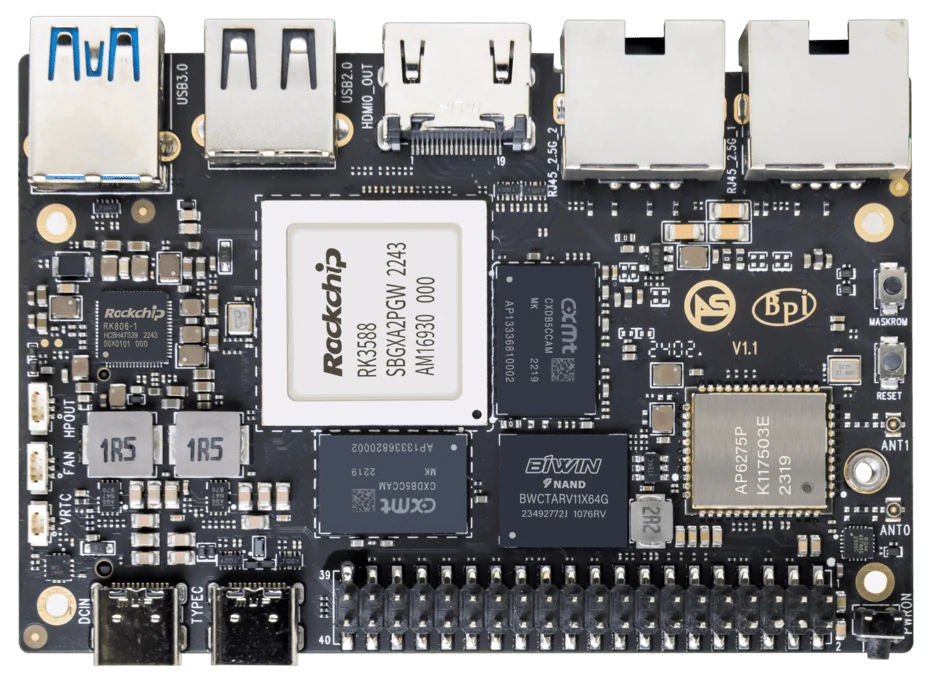
ArmSoM Sige7
Draw the traffic path
Label the equipment network, upstream link and management access. Decide whether the board routes packets, bridges networks or consumes data in an application. These jobs place different demands on CPU, memory and drivers. Port speed alone does not describe forwarding capacity, especially when filtering or encryption is enabled.
Test the functions that consume CPU
NAT, firewall rules, VPN encryption, logging and packet inspection can change throughput substantially. Measure with the real rules enabled and with simultaneous traffic in both directions. A Raspberry Pi with an added network adapter is a different complete configuration from a board with two native connectors, so include adapter behaviour, bus contention and power requirements in the comparison.
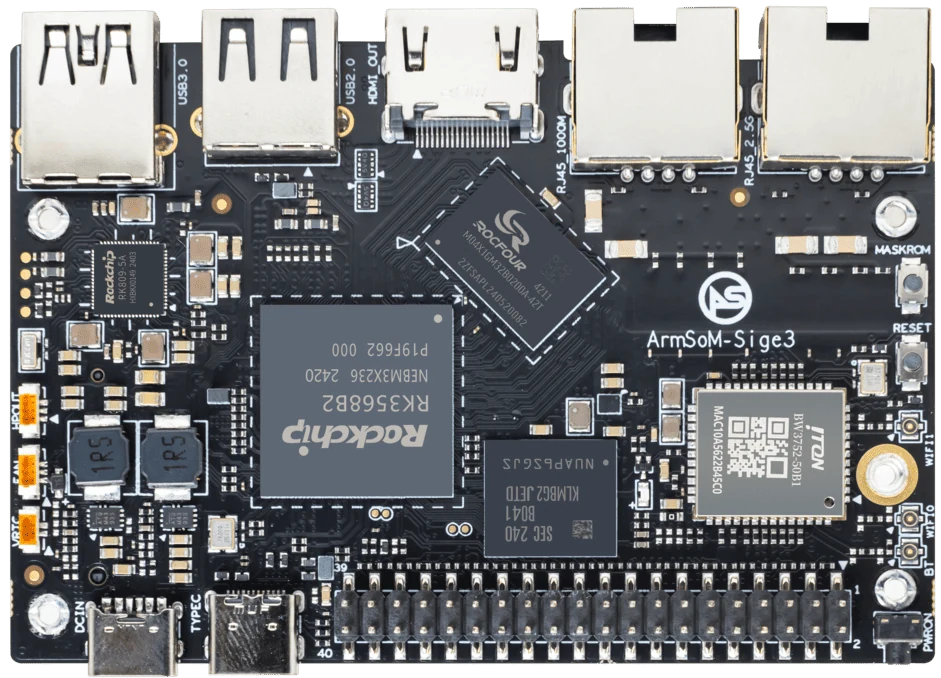
ArmSoM Sige3
Match the choice to your requirements
Requirement or situation | What to evaluate | Decision detail |
Network separation | Define routing or bridging explicitly | Two ports alone do not create isolation. |
VPN gateway | Measure the actual cipher and software | Raw Ethernet speed is not encrypted throughput. |
Storage traffic | Run transfers alongside application work | Avoid a network-only benchmark for a NAS decision. |
Example design
Two ports do not define a network policy
An edge gateway may use one interface for equipment and one for administration. Assign explicit addresses and routes, and decide whether forwarding should occur at all. A dual-port board is not automatically a secure boundary. Test what happens when a cable is moved to the wrong port and when a service binds to every interface. The intended network separation must be expressed in the operating-system configuration and verified from both sides.
Hardware and documentation
Sige7 · RK3588
RK3588, 6 TOPS NPU, dual 2.5GbE and M.2 PCIe 3.0 x4. Check the selected eMMC and wireless configuration.
Hardware documentation · Product details
Sige3 · RK3568B2
RK3568B2 with a 2.5GbE port and a separate Gigabit Ethernet port. Consult the revision-specific manual for expansion and boot support.
Hardware documentation · Product details
Frequently asked questions
Does 2.5GbE guarantee 2.5 Gbit/s file copies?
No. Protocol overhead, storage, clients and CPU work can reduce useful throughput.
Product information and support
Sources
Written by ArmSoM using the documentation below. Example designs are proposals, not measured customer installations.