

Sige5’s RK3576 includes a 6 TOPS NPU, two Gigabit Ethernet ports and M.2 storage expansion. Those features make it a candidate for a camera appliance. Pi 5 deserves a place in the comparison too, especially when the camera, application and accelerator are already working on Raspberry Pi.
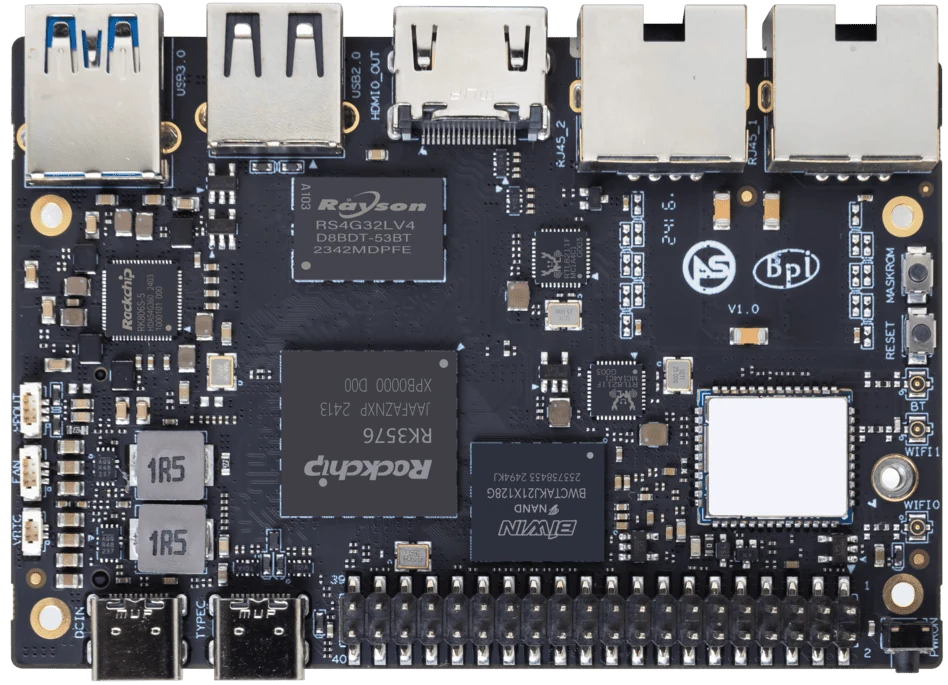
ArmSoM Sige5
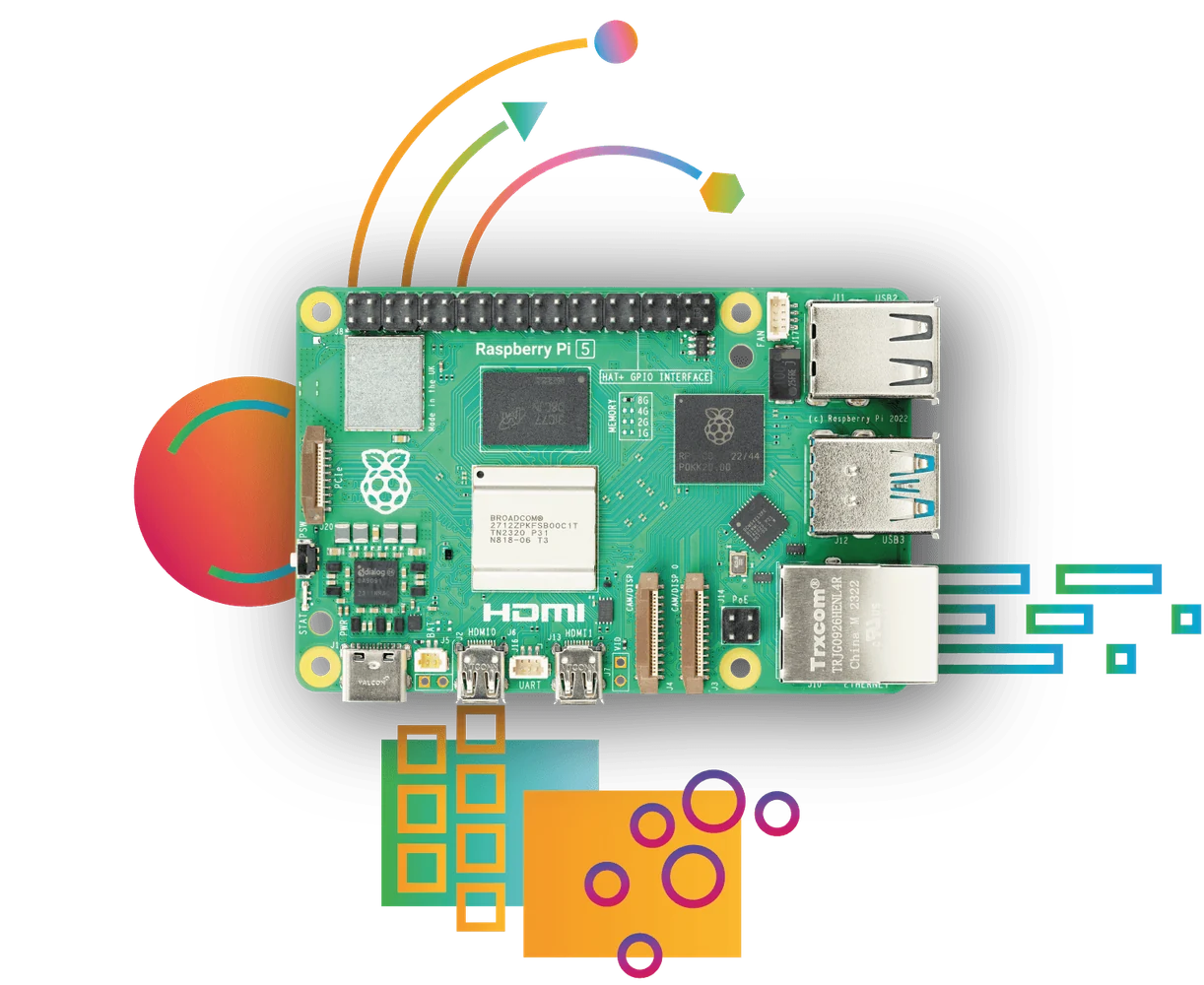
Raspberry Pi 5 Photo: Raspberry Pi
Images identify the boards and are not to physical scale. Pictured configurations and included accessories may differ.
Documented platform comparison
Decision point | Raspberry Pi 5 | ArmSoM Sige5 |
Processor | BCM2712; four Cortex-A76 | RK3576; four Cortex-A72 + four Cortex-A53 |
Integrated NPU | No general-purpose onboard NPU | 6 TOPS |
Wired network topology | One Gigabit Ethernet port | Two Gigabit Ethernet ports |
PCIe expansion | External PCIe 2.0 x1 connection | M.2 PCIe 2.1 x1 |
AI software decision | CPU or specifically selected accelerator | Supported Rockchip RKNN deployment path |
Platform references: Raspberry Pi 5: manufacturer specifications; Sige5 documentation. Board revision, purchased configuration and software support must be checked separately.
Follow a frame through the application
Capture, image conversion, inference and output each consume time. Only some of that work runs on an accelerator. A model that converts successfully can still miss the required response time because preprocessing or unsupported operations run elsewhere. Compare the complete pipeline at the required accuracy, then measure the individual stages to locate delays.
Networking and storage affect the system design
Sige5 documentation lists dual Gigabit Ethernet and an M.2 PCIe 2.1 x1 storage interface. These are useful starting points for an appliance that separates a camera network from an uplink or logs images locally. Raspberry Pi 5 exposes its own networking and external PCIe arrangement. Work out which adapters, cables and power provisions each complete design needs before comparing cost or physical size.
Choose a maintainable software path
If a Raspberry Pi application already meets the required frame rate with its supported camera and libraries, migration may add unnecessary work. Evaluate Sige5 when RK3576’s integrated capabilities or available ArmSoM documentation fit a new design. Maintain a manifest of the OS image, kernel, NPU runtime and model conversion environment so an update does not silently invalidate the original test.
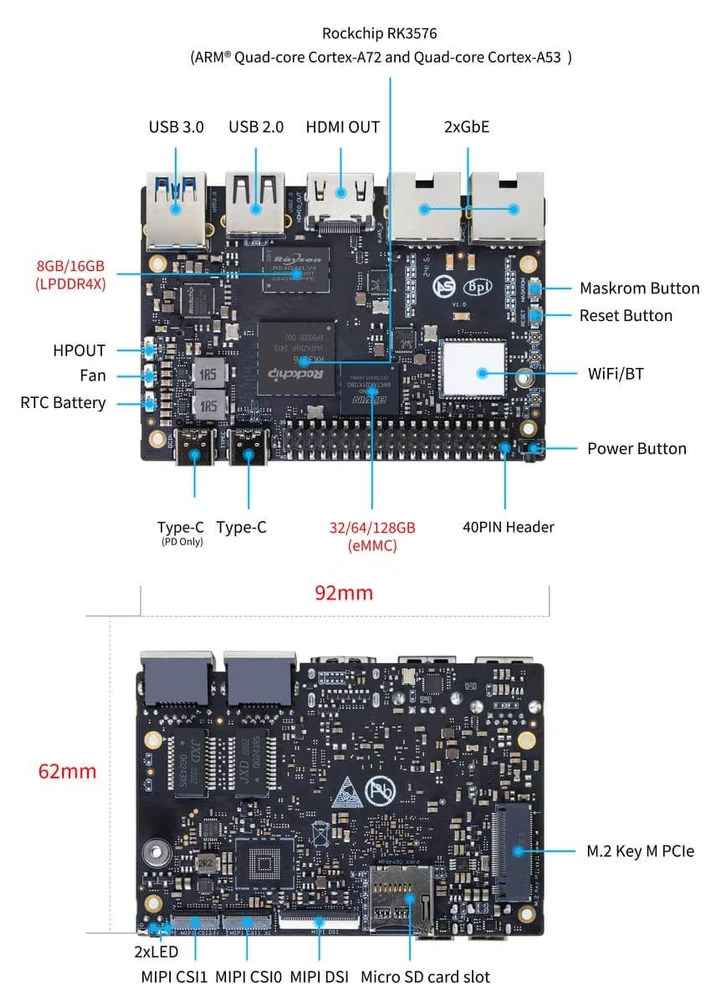
ArmSoM Sige5 board layout reference. Check the current manual before wiring a peripheral.
Match the choice to your requirements
Requirement or situation | What to evaluate | Decision detail |
Camera inference | Validate sensor and model as one pipeline | Input format conversion can dominate latency. |
Two network zones | Inspect the two Sige5 Ethernet interfaces | Separate routing from application throughput tests. |
Existing Raspberry Pi code | Audit board-specific dependencies | A container does not replace kernel drivers. |
Two Ethernet ports need a network plan
Sige5 can connect cameras and an upstream network through separate Gigabit Ethernet ports. Define which network each port serves and how traffic crosses between them. Include any adapters needed by the Pi 5 configuration when comparing power, space and cost.
Example design
An inspection station with two network roles
A production bench might connect cameras or local equipment on one network and send results to an office network on another. That topology makes Sige5’s two Ethernet ports relevant, but it does not prove that the inspection algorithm meets its deadline. First replay a fixed image set, then connect the live camera, and finally add network uploads. This sequence distinguishes model conversion problems from camera and network contention.
Hardware and documentation
Sige5 · RK3576
RK3576, four Cortex-A72 and four Cortex-A53 cores, 6 TOPS NPU, dual Gigabit Ethernet and M.2 PCIe 2.1 x1.
Hardware documentation · Product details
Frequently asked questions
Is Sige5 automatically faster than Pi 5 for AI?
No. The answer depends on the chosen accelerator, model and software path.
Can both run the same application source?
Portable code may transfer, but hardware APIs, binary dependencies and acceleration backends require separate checks.
Product information and support
Sources
Written by ArmSoM using the documentation below. Example designs are proposals, not measured customer installations. Comparisons use published specifications, not head-to-head benchmarks.