

Sige7s puts a Rockchip NPU and removable eMMC on a compact board. Raspberry Pi 5 offers a different route: its own software ecosystem, microSD and external PCIe expansion. The better fit depends on which parts of your application already work and which hardware you still need.
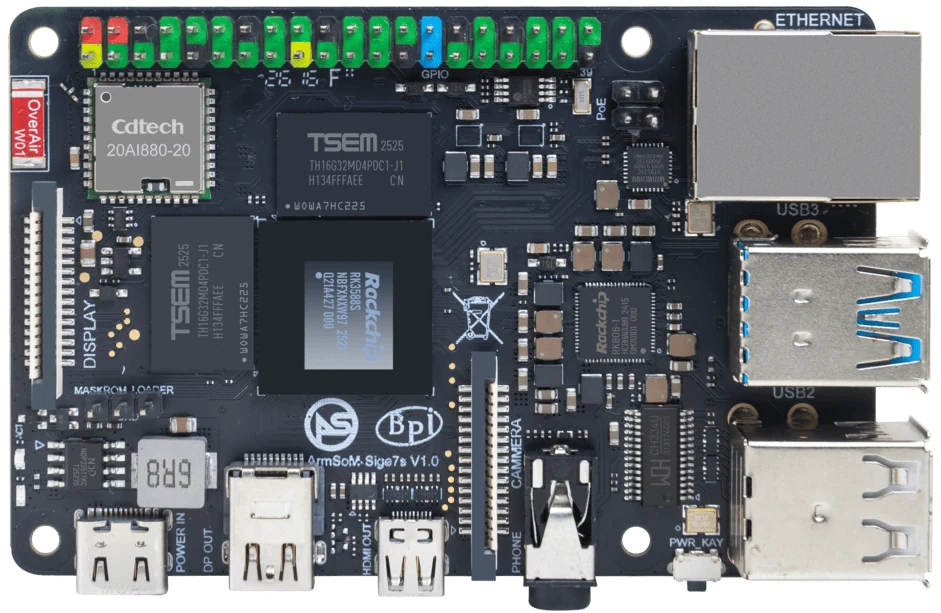
ArmSoM Sige7s
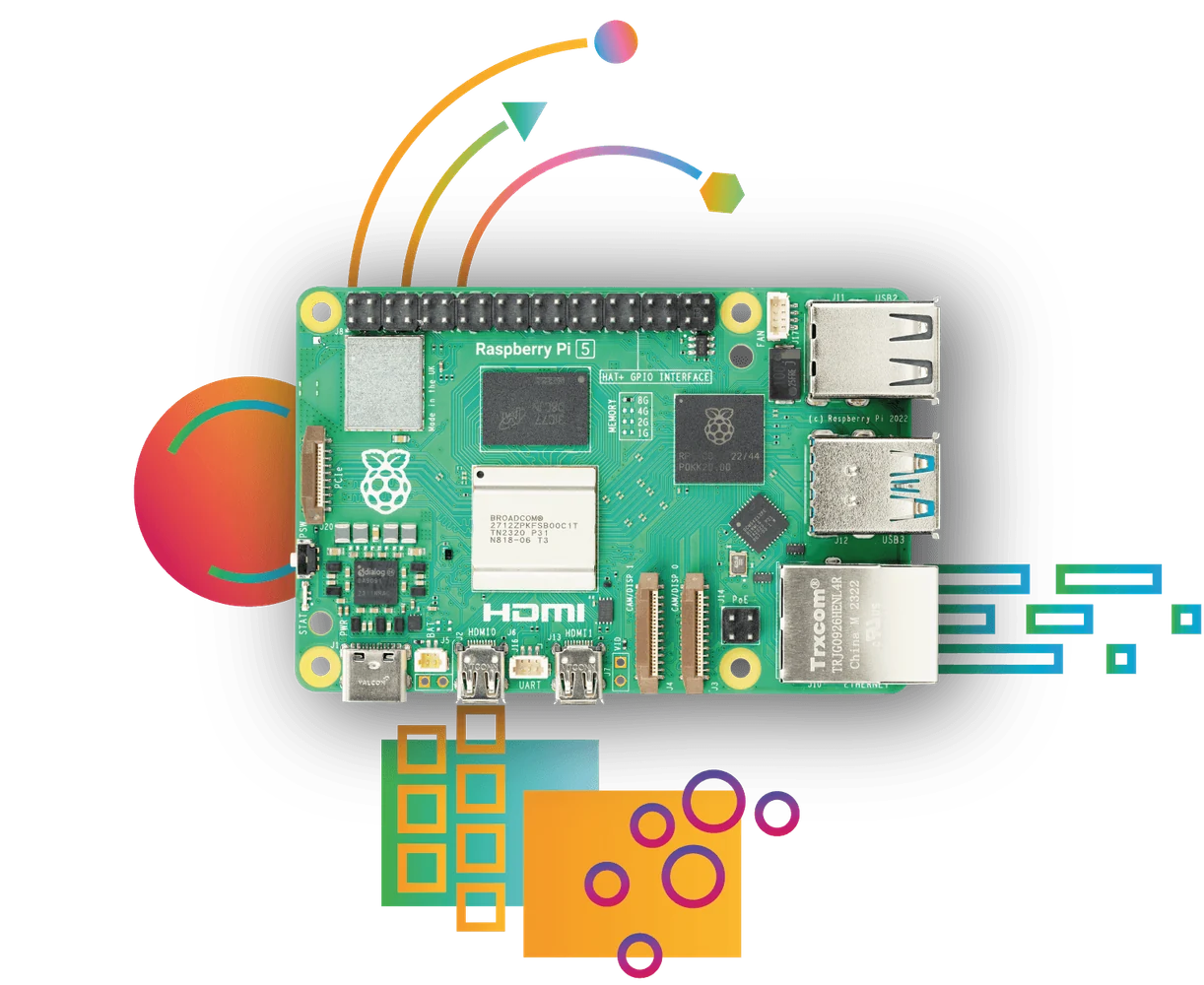
Raspberry Pi 5 Photo: Raspberry Pi
Images identify the boards and are not to physical scale. Pictured configurations and included accessories may differ.
Documented platform comparison
Decision point | Raspberry Pi 5 | ArmSoM Sige7s |
Processor | BCM2712; four Cortex-A76 cores | RK3588S; four Cortex-A76 + four Cortex-A55 |
Onboard AI path | No general-purpose onboard NPU; select an accelerator if needed | Integrated 6 TOPS NPU; model support requires validation |
Wired networking | One Gigabit Ethernet port | One Gigabit Ethernet port |
Storage approach | microSD; external PCIe expansion path | microSD and removable eMMC |
Software and accessories | Raspberry Pi-specific software and accessory support | ArmSoM/Rockchip image and interface validation |
Platform references: Raspberry Pi 5: manufacturer specifications; Sige7s documentation. Board revision, purchased configuration and software support must be checked separately.
Name the accelerator in an AI comparison
Sige7s uses the RK3588S NPU through Rockchip’s supported tools. A Pi 5 application may run inference on the CPU or use an add-on accelerator. Those are different comparisons. Specify the model, accelerator, numerical precision and input size before comparing latency; otherwise, a result can say more about the chosen configuration than either board.
Storage changes the migration plan
Sige7s provides a removable eMMC module arrangement and microSD support. Raspberry Pi 5 provides microSD and an external PCIe connection for compatible expansion. Do not infer a native NVMe socket on Sige7s from RK3588-family marketing. Choose the actual storage device first, then confirm boot support, recovery access and whether its throughput is sufficient for the application. Removable storage helps serviceability only when replacement images and backups are maintained.
Software compatibility can outweigh hardware features
Raspberry Pi camera examples, overlays and GPIO libraries may rely on Raspberry Pi-specific drivers. A Linux application built from portable source is usually a more manageable migration target than an appliance image with undocumented dependencies. On Sige7s, start with the supported image and test display, audio, camera and NPU separately before combining them. Sige7s measures 85 × 56 × 17 mm; enclosure design should still use the current mechanical drawing and connector clearances.
Match the choice to your requirements
Requirement or situation | What to evaluate | Decision detail |
Existing Pi application with HATs | Retain Pi 5 unless the migration has a specific benefit | Inventory pin assignments, overlays and native libraries. |
Integrated NPU project | Evaluate Sige7s with the exact RKNN model | Measure preprocessing, inference and output latency. |
Serviceable embedded storage | Evaluate the removable eMMC configuration | Confirm the purchased module, image and recovery method. |
Plan an eMMC replacement
Replace a Sige7s eMMC module only with the power disconnected. Keep the replacement image, device identity and application data together. On Pi 5, compare the same recovery procedure using the chosen microSD or PCIe storage arrangement.
Example design
A compact vision appliance
For a camera counting objects at an entrance, begin with the acceptable delay between an object appearing and the application recording an event. Convert the same model for each selected accelerator, then compare event accuracy and the age of the processed frames. A system that reports high inference throughput while repeatedly analyzing old frames may miss the operational goal. Add the enclosure, camera cable and storage device before deciding which board makes the smaller complete product.
Hardware and documentation
Sige7s · RK3588S
RK3588S, 6 TOPS NPU, Gigabit Ethernet and removable eMMC. Dimensions: 85 × 56 × 17 mm. Disconnect power before replacing eMMC.
Hardware documentation · Product details
Frequently asked questions
Is Sige7s a drop-in Raspberry Pi 5 replacement?
It is an alternative SBC, not a promise of image, enclosure or accessory interchangeability.
Can I compare NPU TOPS with CPU performance?
No. Use the same task, accuracy target and measured end-to-end latency for a meaningful comparison.
Product information and support
Sources
Written by ArmSoM using the documentation below. Example designs are proposals, not measured customer installations. Comparisons use published specifications, not head-to-head benchmarks.