

P2 Pro and Raspberry Pi Zero 2 W both suit compact Linux projects, but they occupy different spaces. P2 Pro emphasizes wired networking and audio interfaces. Zero 2 W follows the narrower Raspberry Pi Zero format and its established accessory layout.
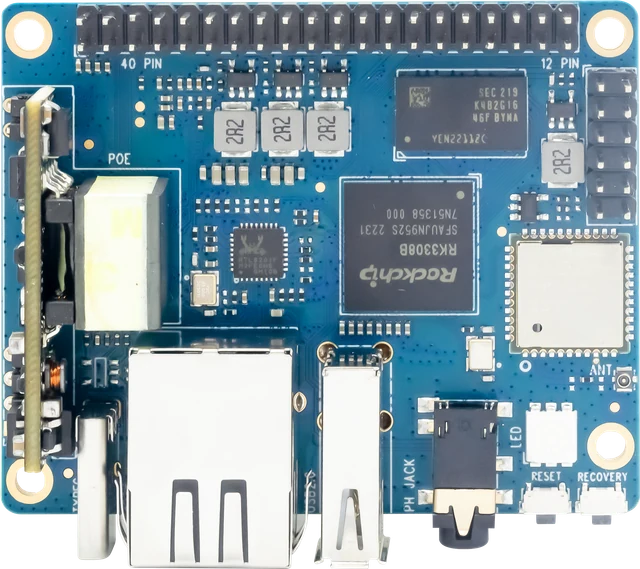
ArmSoM P2 Pro
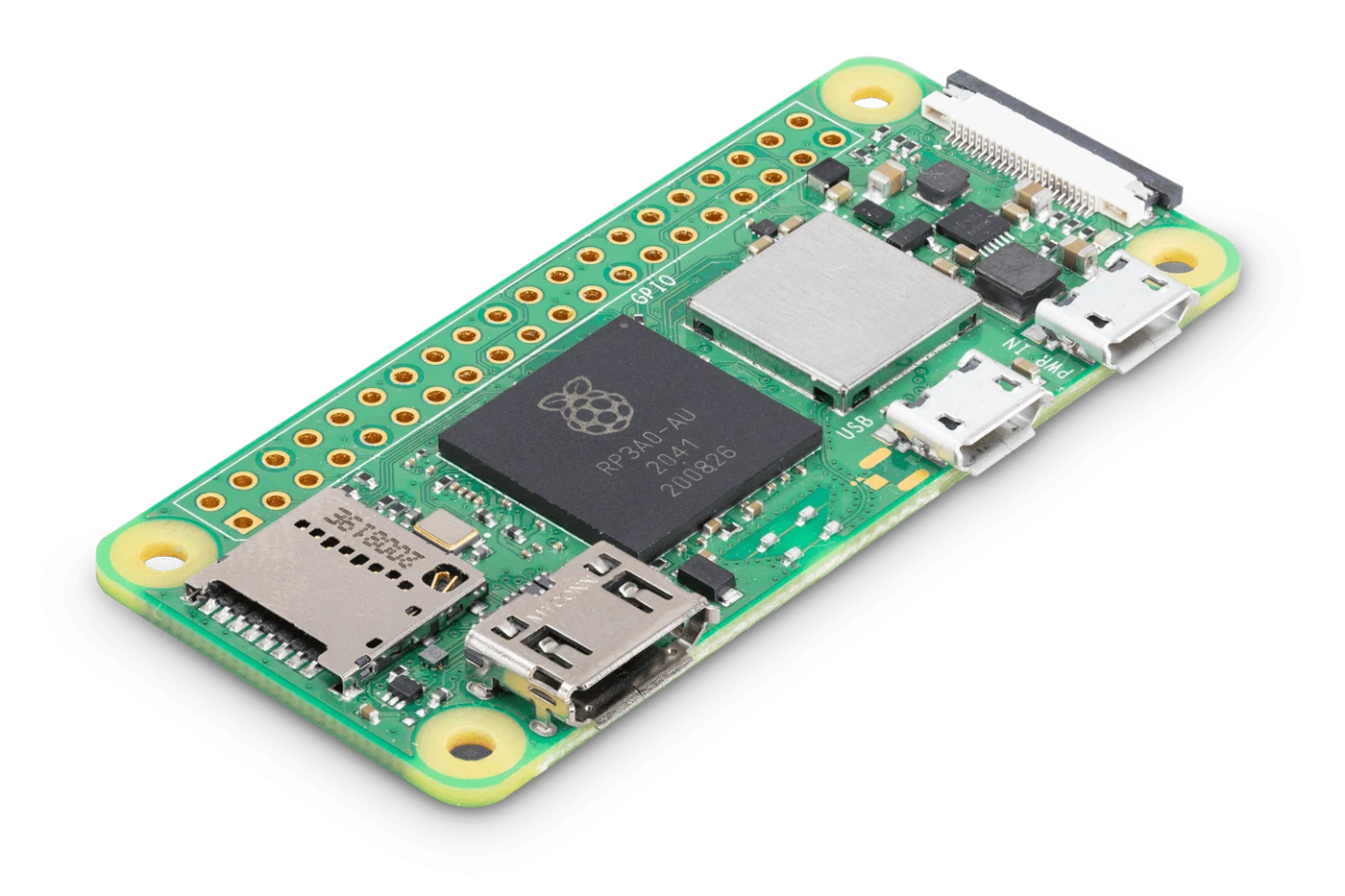
Raspberry Pi Zero 2 W Photo: Raspberry Pi
Images identify the boards and are not to physical scale. Pictured configurations and included accessories may differ.
Documented platform comparison
Decision point | Raspberry Pi Zero 2 W | ArmSoM P2 Pro |
Processor | Four Cortex-A53 cores | RK3308B-S; four Cortex-A35 cores |
Memory | 512 MB | 256 MB / 512 MB documented variants |
Board dimensions | 65 × 30 mm | 65 × 52.5 mm |
Wired Ethernet | No onboard Ethernet connector | 100 Mbps Ethernet |
Audio integration emphasis | Choose a supported audio interface/accessory | Documented PDM, I2S and audio connections |
Boot/storage | microSD | microSD; optional eMMC |
Platform references: Raspberry Pi Zero 2 W: manufacturer specifications; P2 Pro documentation. Board revision, purchased configuration and software support must be checked separately.
Audio hardware changes the parts list
P2 Pro’s documented PDM and I2S interfaces make it relevant to microphone and audio designs. The available signal path still needs a matching device, driver and configuration. For either board, identify the microphone or codec and the capture format before choosing adapters. A connector photograph cannot tell you which audio channels a particular image exposes.
Size and networking can settle the decision
Raspberry Pi Zero 2 W is documented as 65 × 30 mm with wireless networking and 512 MB memory. P2pro is documented as 65 × 52.5 mm and includes wired Ethernet. A narrow enclosure may favour the Zero form factor; a fixed gateway may value a physical network connection. These are practical differences that do not require a speculative CPU benchmark.
Treat memory as a software budget
A small board can run a focused service without being suitable for a heavy desktop stack. Inventory the audio buffers, application runtime, network services and update mechanism. Measure memory usage during the worst sustained workload, not immediately after boot. Select the available P2pro memory/storage configuration from the store and preserve a recovery image.
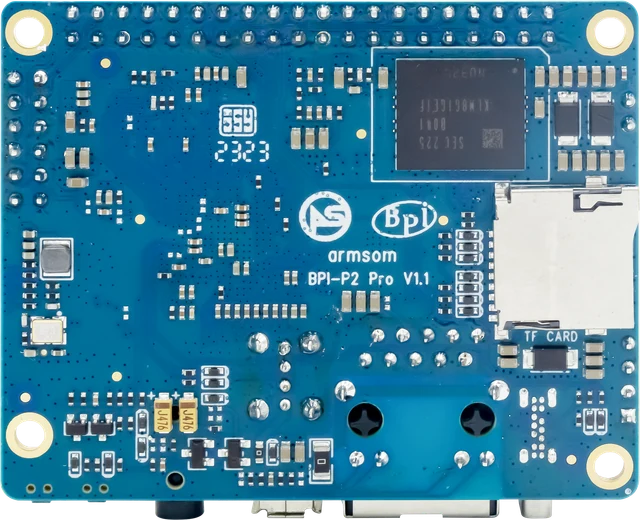
ArmSoM P2 Pro rear view from the existing product-media library.
Match the choice to your requirements
Requirement or situation | What to evaluate | Decision detail |
Very narrow enclosure | Check Zero 2 W dimensions | Include cables, headers and cooling clearance. |
Wired embedded audio appliance | Evaluate P2pro | Verify audio codec routing and Ethernet on the chosen image. |
Existing Pi Zero software | Keep a known-good baseline | Native libraries and pin mapping still require migration. |
Budget the audio software as well as the connectors
Check native codec or speech-library support for the selected image. Capture buffers, resampling, networking and the recognition engine share limited memory. Build a stable capture and playback path first, then measure the chosen algorithm. Microphone placement and the enclosure will also affect the result.
Example design
A wired audio endpoint
Imagine a device that captures audio, performs a modest local processing task and sends selected events over Ethernet. P2 Pro’s documented audio connections and wired network may reduce the external hardware required. A narrow battery-powered device using existing Raspberry Pi software can favor Zero 2 W instead. Estimate the audio buffers, codec processing and network queue before choosing a memory configuration. This exercise does not assume that either board can run an arbitrary speech model.
Hardware and documentation
P2 Pro · RK3308B-S
RK3308B-S, 256 MB / 512 MB DDR3, 100 Mbps Ethernet, PDM and I2S audio. Board size: 65 × 52.5 mm. Storage and power accessories depend on the ordered configuration.
Hardware documentation · Product details
Frequently asked questions
Is P2pro a pin-compatible Pi Zero replacement?
No such blanket claim is made. Compare mechanical, electrical and software requirements separately.
Can a 512 MB board run a voice application?
Possibly, if the selected audio processing and model fit its measured memory and CPU budget. Test the actual pipeline.
Product information and support
Sources
Written by ArmSoM using the documentation below. Example designs are proposals, not measured customer installations. Comparisons use published specifications, not head-to-head benchmarks.