

ArmSoM Sige5 combines onboard Wi-Fi 6, Bluetooth 5.3, dual Gigabit Ethernet and a 40-pin header on an RK3576 platform. It is a useful NanoPi M5 alternative for connected controllers that need wired and wireless links from the first prototype. Compare memory, storage and expansion requirements before choosing a configuration.
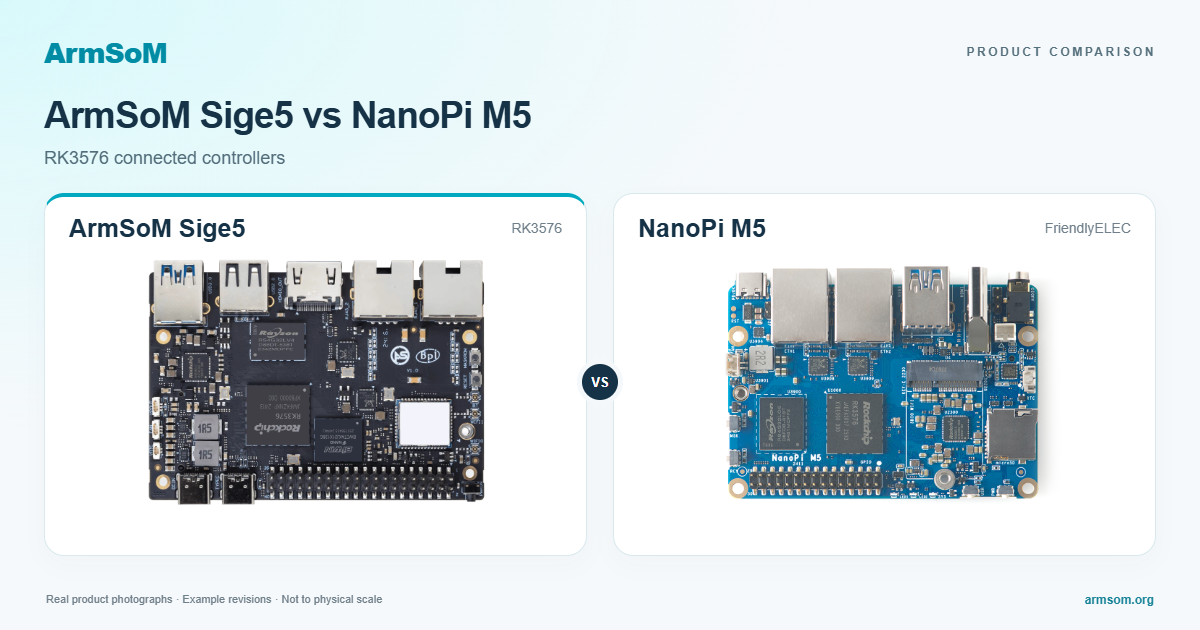
Product photographs: ArmSoM; FriendlyELEC. Example hardware revisions are shown independently fitted, not to physical scale. The comparison does not imply a partnership between the brands.
Specifications at a glance
Design question | ArmSoM Sige5 | FriendlyELEC NanoPi M5 |
SoC / NPU | RK3576 / 6 TOPS | RK3576 / 6 TOPS |
Board footprint | 92 × 62 mm | 90 × 62 mm |
Wired network | 2 × Gigabit Ethernet | 2 × Gigabit Ethernet |
Wireless | Onboard Wi-Fi 6 + Bluetooth 5.3 | Optional M.2 SDIO wireless module |
Memory | LPDDR4/4x options | 4GB LPDDR4X; 8/16GB LPDDR5 |
Storage approach | Onboard eMMC options + microSD | Optional UFS + microSD |
NVMe | M.2, PCIe 2.1 ×1 | M.2, PCIe 2.1 ×1 |
Expansion header | 40-pin | 30-pin |
The same processor, different integration choices
Sige5 and NanoPi M5 address an appealing middle ground: a Rockchip RK3576 CPU, local AI acceleration and more connectivity than a minimal development board. Both have two Gigabit Ethernet ports and an M.2 NVMe path. For a connected controller, those shared features can matter more than a small difference in board dimensions.
The choice becomes clearer when you decide how the product will connect wirelessly, where its operating system and data will live, and which low-speed interfaces it needs. Those decisions reveal the value of each board's implementation.
Sige5's advantage: more of the wireless system is on the board
Sige5 includes Wi-Fi 6 and Bluetooth 5.3. NanoPi M5 provides an optional M.2 SDIO wireless route. For a product that requires wireless connectivity from the first prototype, Sige5 avoids selecting and installing a separate module. Confirm antenna arrangements and the supported image rather than assuming the enclosure will have the same RF performance as an open board.
The 40-pin header also offers a familiar physical format for prototype wiring. NanoPi M5 has a 30-pin header. Neither header should be treated as a universal Raspberry Pi accessory guarantee: pin assignments, voltages and enabled functions decide compatibility. Sige5's guide includes a revision-specific pin table, which is a useful starting point for wiring a custom peripheral.
Sige5 is especially relevant when the team already works with ArmSoM CM5. Both use RK3576, so application-level experimentation on an SBC may inform a later module-based design. The carrier, boot configuration and peripherals still need their own validation.
Memory and storage configurations
The NanoPi M5 specification lists optional UFS 2.0 and different memory types by capacity. A buyer comparing an 8GB or 16GB configuration should recognize the listed LPDDR5 rather than assume that all NanoPi M5 variants use the 4GB model's LPDDR4X.
UFS can be a useful option when the application needs onboard storage with a different performance profile. Test the exact device and workload before claiming an advantage over Sige5 eMMC. A storage-interface name alone does not establish latency, endurance or recovery behaviour.
FriendlyELEC lists operating-system options including FriendlyWrt and OpenMediaVault. Compare the required application and peripheral drivers with the available Sige5 images as part of software selection; an existing installation provides a useful baseline for the ArmSoM prototype.
When the product needs faster networking
Both products in this comparison have dual Gigabit Ethernet. If the application needs two 2.5GbE links, move the shortlist to a different board, such as Sige7, instead of assuming an RK3576 specification implies faster network ports. Likewise, their PCIe 2.1 one-lane NVMe paths should not be compared with a four-lane PCIe 3.0 board as though they were equivalent.
A useful prototype: wired equipment plus wireless maintenance
For a controller with two wired networks and a wireless maintenance connection, begin with Sige5. Verify both wired interfaces, wireless reconnect and the application together. Include the actual sensor or serial adapter and watch for changes under sustained storage writes.
For the purchase comparison, include equivalent RAM, boot storage, power and cooling. Add any separate wireless module required by the alternative layout. Sige5 brings wireless onto the board, making the component list for a wired-and-wireless controller simpler to define.
Send ArmSoM the intended sensors, serial devices, display and storage configuration. Review the corresponding connector functions on the supplied Sige5 revision, then use that complete layout for the sample build.
Frequently asked questions
What makes Sige5 a useful NanoPi M5 alternative?
Sige5 combines onboard Wi-Fi 6 and Bluetooth 5.3 with dual Gigabit Ethernet, one-lane NVMe expansion and a 40-pin header. That combination suits controllers needing both wired equipment links and wireless connectivity.
Does either board offer PCIe 3.0 ×4 NVMe?
No. Both list a PCIe 2.1 one-lane NVMe connection. Sige7 is a different option when a four-lane PCIe 3.0 connection is required.
Evaluate ArmSoM Sige5 for your product
Send ArmSoM your required RAM, storage, interfaces, operating system and expected volume. Start with the product and hardware guide below to discuss an appropriate sample configuration.
Sources and comparison method
Published by ArmSoM. This selection guide compares documented hardware features; it is not a head-to-head benchmark. References reviewed on 23 November 2026. Confirm the supplied revision, configuration and software support when ordering.