Eight cores. More possibilities.
Four Cortex-A76 performance cores and four Cortex-A55 efficiency cores bring application processing to your custom hardware.
RK3588 · 8nm · up to 2.4GHz
Small module.
Big ideas, built at the edge.
Octa-core processing, 6 TOPS AI and up to 32GB memory. A compact computing foundation for your next embedded product.
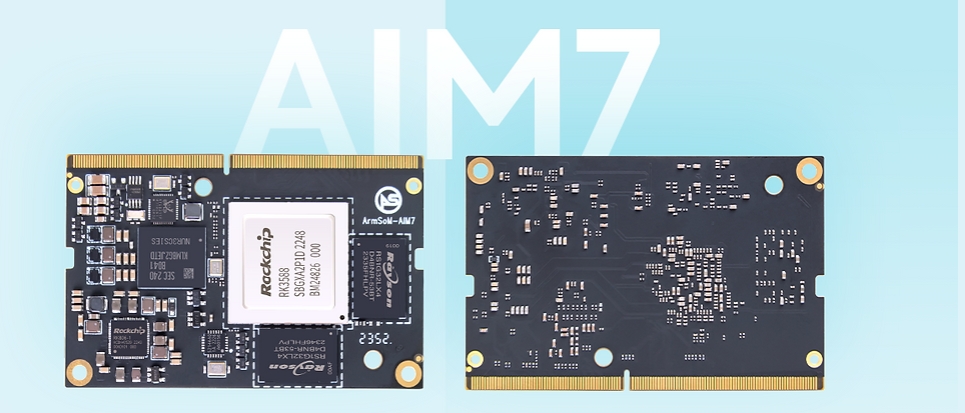
CPU, NPU, memory and eMMC.
One module. Your carrier board.
From the first prototype to a custom carrier board, start with compute that fits your design.
Four Cortex-A76 performance cores and four Cortex-A55 efficiency cores bring application processing to your custom hardware.
RK3588 · 8nm · up to 2.4GHzRun inference locally with the integrated Rockchip NPU. Build your model deployment workflow with the RKNN toolchain.
6 TOPS · INT4 / INT8 / INT16Choose from 8GB, 16GB or 32GB LPDDR4x, with onboard eMMC storage for your operating system and applications.
Up to 32GB RAM · up to 128GB eMMCHardware video decoding and encoding support high-resolution vision and media applications without relying on CPU processing alone.
Up to 8K60 decode · 8K30 encodeBring cameras, storage, displays and industrial peripherals together through a purpose-built carrier board.
PCIe 3.0 ×4 · MIPI CSI · USB 3.0A 260-pin SO-DIMM module puts core processing, memory and storage into a small footprint for embedded product development.
69.6 × 45mm · 17.3gCompact hardware. Clearly defined interfaces.
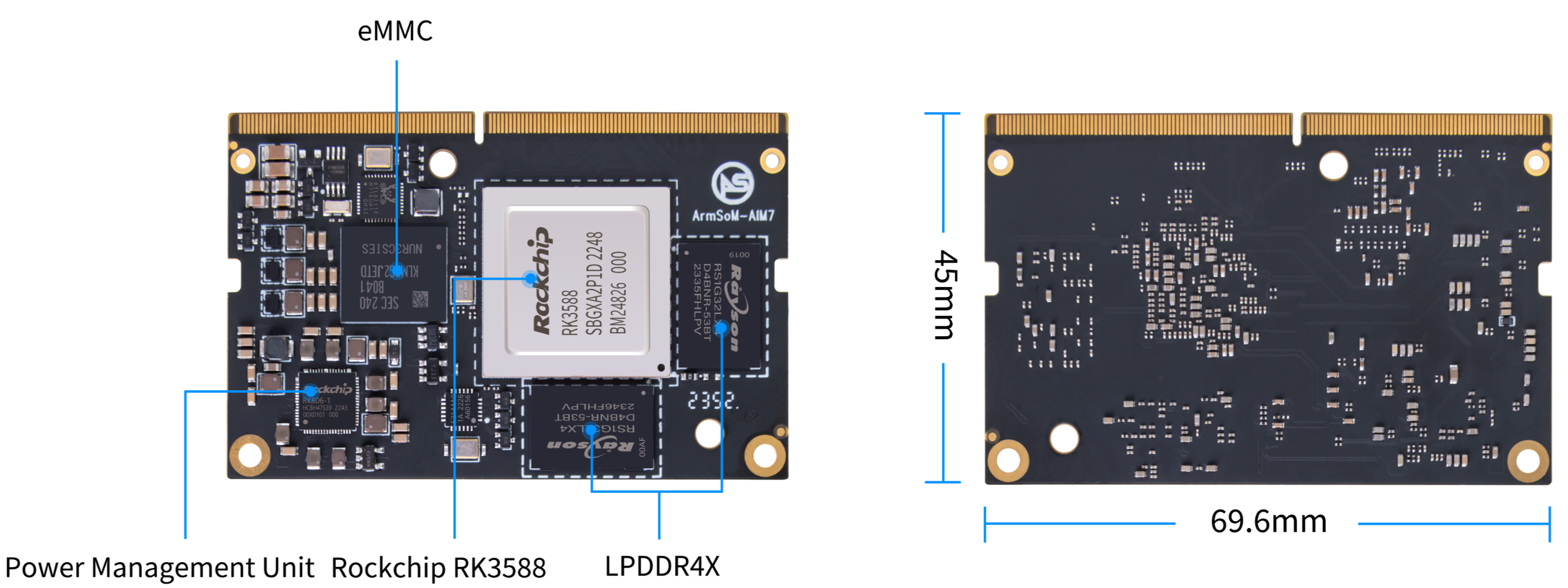
RK3588 processor, onboard memory and eMMC in a compact module.
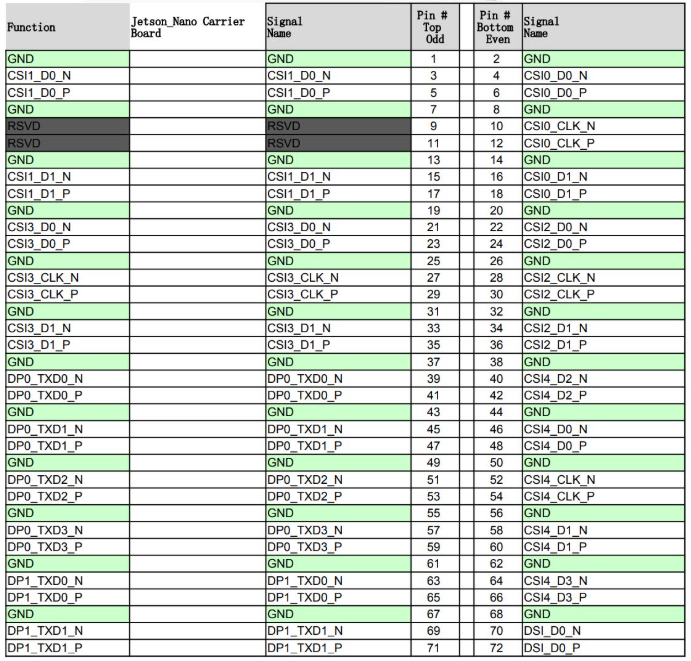
Review the complete signal definitions before carrier-board design.
Application compute meets dedicated AI.
Use the octa-core CPU for application logic, the Mali GPU for graphics, and the dedicated NPU for supported inference workloads.
Hardware video processing and fast memory help connect the pieces, whether you are building a vision system, a media device or a compact embedded computer.
Explore the hardware specificationsBuild an on-device inference workflow with the Rockchip RKNN toolchain.
Integrated NPU · INT8 compute
Start with a supported model and check operator compatibility.
Use the RKNN tools to convert, quantize and validate for the target.
Integrate inference into your application and test on real hardware.
NPU performance depends on the model, precision and software configuration. Open the AI development guide ↗
Cameras, displays, storage and control — exposed through your carrier-board design.
High-speed storage & expansion
Additional peripheral connectivity
Multi-camera input configurations
Display output via carrier board
External display connectivity
Connect host peripherals
RGMII / RMII Ethernet signals
Embedded control & sensors
Use the block diagram to map out your application, then refer to the full documentation for pin functions and multiplexing.
Available ports and simultaneous interface configurations depend on the carrier board and software support.
View hardware documentation ↗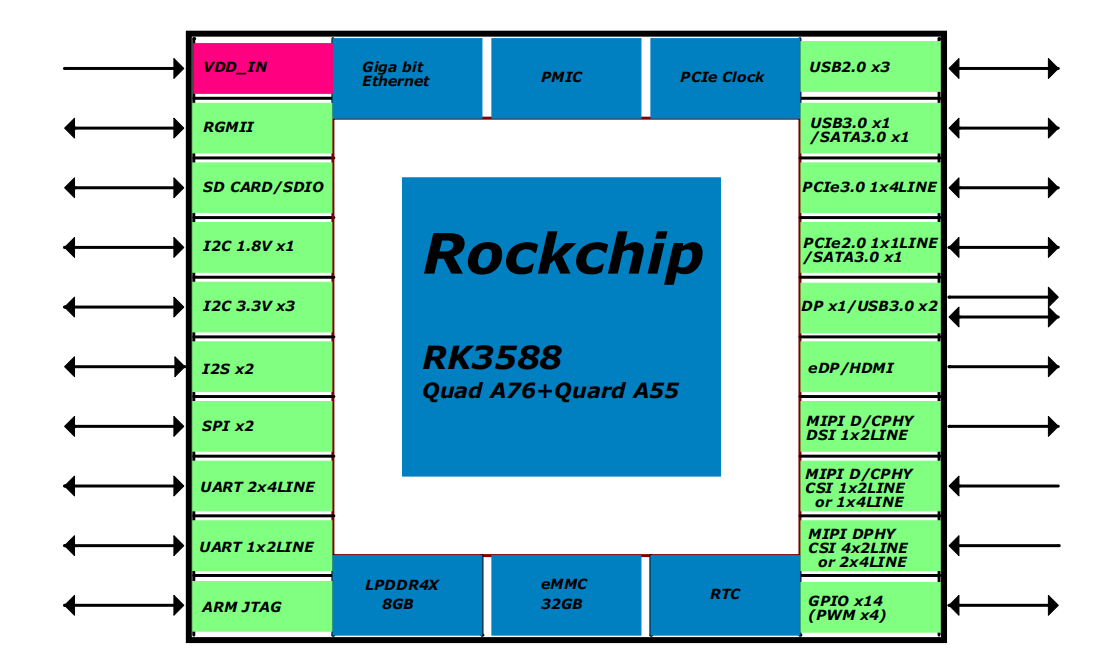
A flexible foundation for developers and embedded product teams.
Combine camera input and local inference for inspection, detection and vision prototypes.
Bring application compute, sensors and peripheral control together on your carrier board.
Build around hardware video processing, camera connectivity and high-speed storage.
Design compact ARM systems with memory options for your application requirements.
Use this overview for selection. Refer to the documentation for design-level details.
| Specification | ArmSoM AIM7 |
|---|---|
| Processor | Rockchip RK3588 · 8nm process |
| CPU | 4 × Cortex-A76 up to 2.4GHz + 4 × Cortex-A55 up to 1.8GHz |
| GPU | Arm Mali-G610 MP4 |
| NPU | 6 TOPS (INT8); INT4 / INT8 / INT16 mixed-precision support |
| Memory | 8GB / 16GB / 32GB · 64-bit LPDDR4x (default: 8GB) |
| Storage | 32GB / 64GB / 128GB onboard eMMC (default: 32GB) |
| Video decoding | Up to 8K60 H.265 / VP9 / AVS2; 8K30 H.264; 4K60 AV1 |
| Video encoding | Up to 8K30 H.264 / H.265 |
| Display signals | 1 × DisplayPort; 1 × HDMI / eDP combo interface |
| Camera signals | MIPI CSI: 3 × 4-lane or 5 × 2-lane configurations |
| PCIe | PCIe 3.0 ×4 and PCIe 2.1 ×1 |
| USB | 1 × USB 3.0 Gen 1 + 3 × USB 2.0 |
| Networking | 1 × GMAC with RGMII / RMII for carrier-board Ethernet |
| Peripheral signals | UART, SPI, I²C, I²S, CAN, PWM and GPIO; see pin definitions for multiplexing |
| Connector | 260-pin SO-DIMM edge connector |
| Power input | 5V DC |
| Operating temperature | 0°C to 80°C |
| Storage temperature | −20°C to 85°C |
| Dimensions / weight | 69.6 × 45mm / 17.3g |
| PCB | 12-layer PCB |
Configurations shown are documented options. Current availability is listed in the store. Interface support depends on your carrier board and operating system.
Hardware files, system images and source code, all within reach.
Specifications, interfaces & pin definitions
AIM family setup and development guide
Schematics, layout & mechanical resources
ArmSoM Rockchip kernel repository
Rockchip RKNN / LLM documentation
Official and community image download links
Official and community system support varies by image. Check the documentation for current versions and peripheral support.
AIM7 is a system-on-module, so it needs a compatible carrier board, a suitable 5V power supply and cooling for your workload. Follow the AIM family getting-started guide for image installation and setup.
Yes. ArmSoM has tested AIM7 with the NVIDIA Jetson Nano B01 carrier board and confirmed compatibility. Use an AIM7-compatible Rockchip system image. For other carrier boards, check the pinout, power requirements and peripheral configuration separately.
The documented configurations are 8GB, 16GB and 32GB LPDDR4x, with 32GB, 64GB or 128GB onboard eMMC. Check the store for currently available combinations.
The documentation provides links for Debian, Android and Buildroot, alongside community options including Armbian and Ubuntu. Image versions and supported peripherals vary; use the current product documentation to choose an image.
Use the Rockchip RKNN toolchain to convert and optimize supported models, then run them on the integrated NPU. Follow the ArmSoM AI documentation for supported operators, conversion steps and deployment examples.
The hardware resources include schematics, layout and mechanical documentation. Review these files and the full pin-definition table before designing your carrier board, including interface multiplexing and power requirements.
Explore module options or talk to us about your carrier board and integration needs.