

Both ROCK 5T and Sige7 provide two 2.5GbE ports. Sige7 fits them on a 92 × 62 mm board with a single PCIe 3.0 ×4 NVMe connection. ROCK 5T uses a larger layout for two SSD sockets, cellular expansion and additional display connections. This is a choice about the complete appliance.
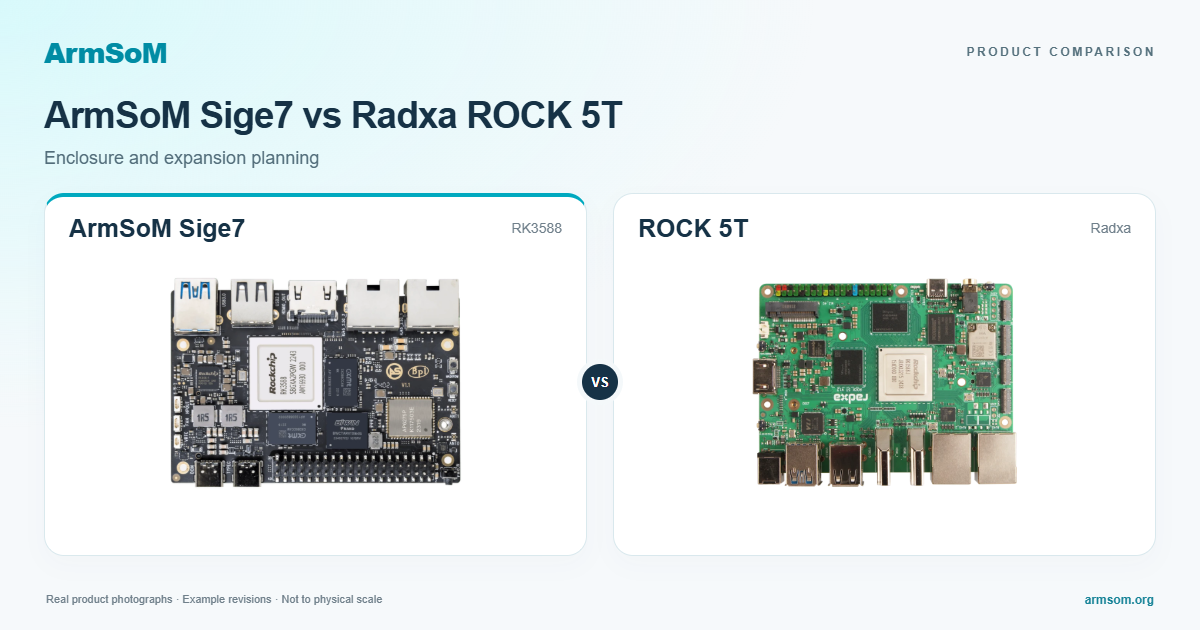
Product photos: ArmSoM; Radxa. Whole boards, independently fitted and not shown to physical scale. The comparison does not imply a partnership between the brands.
Specifications at a glance
Design factor | ArmSoM Sige7 | Radxa ROCK 5T |
Процессор | RK3588 | RK3588 / RK3588J variants |
PCB footprint | 92 × 62 mm | 110 × 82 mm |
Ethernet | 2 × 2.5GbE | 2 × 2.5GbE |
NVMe | 1 × M.2, PCIe 3.0 ×4 | 2 × M.2, each PCIe 3.0 ×2 |
Семья памяти | LPDDR4 / LPDDR4x | LPDDR5 |
Cellular expansion | External integration required | M.2 B-key and SIM slot |
HDMI capture | No onboard HDMI input | HDMI input listed |
Industrial grade | Check required environment against Sige7 rating | Separate industrial-grade variant listed |
The ArmSoM advantage starts with the enclosure
A two-network edge computer does not always need the expansion of a larger carrier-style board. Sige7 combines two native 2.5GbE ports, onboard Wi-Fi 6 and one NVMe connection in a smaller footprint than ROCK 5T. This suits a fixed-function appliance with one internal drive and a known set of external connections.
The smaller PCB can help when fitting a control cabinet, desktop gateway or embedded terminal. Check the entire stack before assigning a size saving: the heatsink, drive, antenna cables, connectors and service access may define the enclosure dimensions. The two boards do not share a mounting plan.
One four-lane SSD or two two-lane SSDs?
Sige7 allocates four PCIe 3.0 lanes to one M.2 connection. ROCK 5T supplies two M.2 M-key sockets with two lanes each. A product built around one drive can use Sige7's wider link. A product needing two internal drives can benefit from ROCK 5T's two sockets without adding an external storage assembly.
Lane counts are not measured file-transfer rates. Drive behaviour, filesystem choice, thermal throttling and application access patterns all influence results. Nor do two sockets establish a redundant storage system: backup, recovery and any mirroring arrangement require their own design.
Where the extra ROCK 5T space earns its place
Radxa documents an M.2 B-key connector with a SIM slot, HDMI input and several display outputs. Those features are relevant for a cellular appliance or a capture system. If the product needs them, comparing only board area would miss the cost and space of adding equivalent functions elsewhere.
ROCK 5T also has consumer and industrial variants. The industrial version's temperature rating belongs to that selected variant. Sige7 should be evaluated against its own published operating conditions and the final enclosure. This guide does not treat Sige7 as a replacement for an industrial-grade qualification requirement.
Build a workload around two active networks
For a local inspection server, one network might connect the cameras or equipment while the other connects to an upstream system. Run acquisition, inference, database writes and data transfer concurrently. Monitor service latency and packet loss, not just the negotiated Ethernet speed.
Use the production encryption, filtering and storage policy during testing. A link advertised at 2.5GbE does not promise that the application, VPN or firewall will sustain that rate. Record power and temperature after the system reaches its normal operating state.
Choose the smaller board only when its I/O is sufficient
Sige7 is a sensible candidate when the final design requires two fast wired links, wireless connectivity and one internal SSD. Its combination of those connections with a smaller board is the relevant advantage over ROCK 5T.
ROCK 5T deserves evaluation when dual SSDs, cellular integration, HDMI capture or its industrial variant remove work from the project. Compare populated configurations and all required accessories. Avoid paying for unused expansion, but do not discard expansion that eliminates a separate board, cable or enclosure compartment.
Questions before you choose
Do both boards have two 2.5GbE ports?
Yes. Their storage, board dimensions and expansion options differ, so a second Ethernet port alone does not distinguish them.
Is Sige7 faster because its SSD link has four lanes?
It offers a wider link to one drive. Actual storage and application performance require measurement; ROCK 5T offers two separate two-lane SSD connections.
Evaluate ArmSoM Sige7 for your application
Check your required interfaces, software image, memory and storage configuration before choosing a prototype. Исследуйте ArmSoM Sige7 и read the hardware documentation.
References and comparison method
Published by ArmSoM. This guide compares manufacturer specifications checked on 25 November 2026. Recommendations reflect the documented interfaces and application requirements; this is not a hands-on benchmark or a compatibility certification.