

Sige3 gives an RK3568-based product a 2.5GbE port, a Gigabit Ethernet port and onboard Wi-Fi 6. ROCK 3A offers a single Gigabit Ethernet connection, M.2 wireless expansion and more Type-A USB connections. Sige3’s main advantage is the network hardware already on the board.
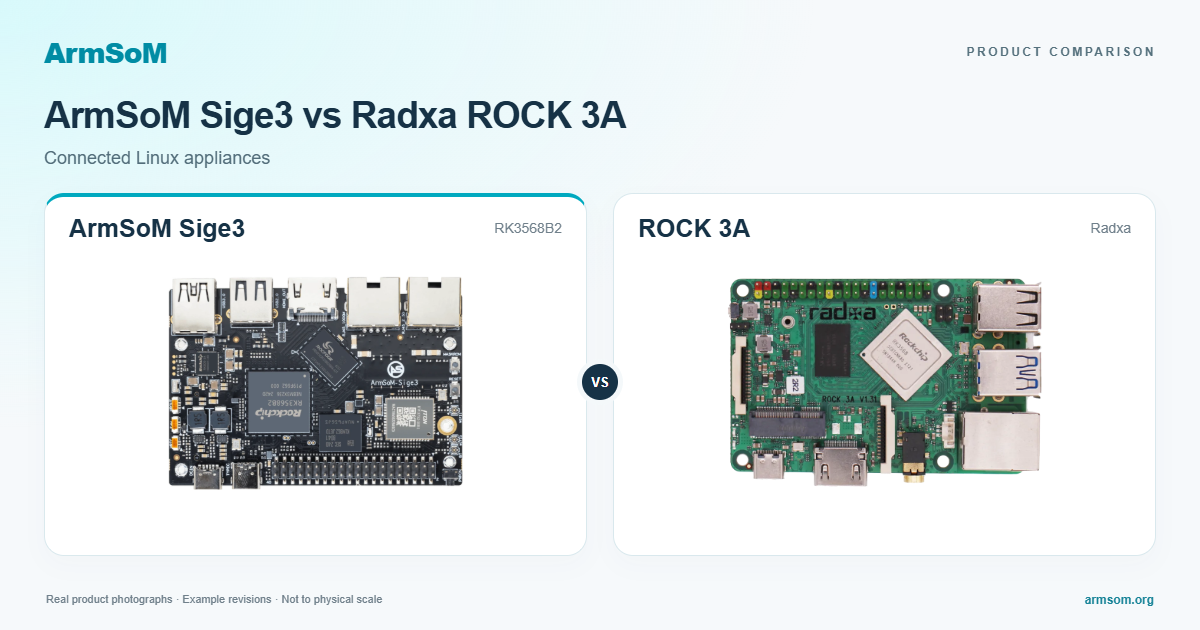
Product photos: ArmSoM; Radxa. Whole boards, independently fitted and not shown to physical scale. The comparison does not imply a partnership between the brands.
Specifications at a glance
Design factor | ArmSoM Sige3 | Radxa ROCK 3A |
Процессор | RK3568B2 | RK3568 |
CPU family | 4 × Cortex-A55 | 4 × Cortex-A55 |
Ethernet | 1 × 2.5GbE + 1 × Гигабитный Ethernet | 1 × Gigabit Ethernet |
Беспроводная связь | Onboard Wi-Fi 6 + Bluetooth | Optional M.2 E-key wireless module |
SSD connection | M.2 M-key, PCIe 3.0 ×2 | M.2 M-key, PCIe 3.0 ×2 |
USB layout | 2 × USB 2.0 Type-A; USB-C 3.0 | 2 × USB 2.0 + 2 × USB 3.0 Type-A |
Expansion header | 40-pin; check Sige3 pin functions | 40-pin; check ROCK 3A pin functions |
Separate the equipment network from the uplink
A connected appliance often sits between a machine and the rest of the site. Sige3 provides two physical wired connections, allowing the application to use one for equipment and one for upstream access. Its 2.5GbE connection also gives a suitable local network more link capacity than a Gigabit-only port, although application throughput still needs testing.
ROCK 3A can be a straightforward choice for a device that only needs one wired network. Adding another network interface is possible through external hardware, but that changes the enclosure, cabling and device-management plan. Those additional parts belong in the comparison.
Wi-Fi is integrated on Sige3
Sige3's onboard Wi-Fi 6 and Bluetooth remove the need to select a separate M.2 radio module for the initial configuration. ROCK 3A exposes an E-key socket and Radxa documents compatible wireless expansion. The modular approach can be useful when the project requires a particular supported radio.
For Sige3, the practical benefit is fewer separate components to source and install. It is not proof of better radio range or access-point performance. Test the operating mode you need with the intended system image and antenna placement. A client connection working in an open lab is not the same test as an access point inside a metal enclosure.
NVMe is a shared capability
Both boards document an M.2 M-key connection using two PCIe 3.0 lanes. Sige3 should therefore not be promoted as having a unique NVMe advantage over ROCK 3A. Compare the permitted SSD sizes, mounting position and cooling clearance instead.
An appliance that logs data continuously should also have a retention policy and recovery procedure. Confirm storage health reporting, behaviour when the volume fills and restart after an interrupted write. These are system design questions that matter on either board.
ROCK 3A has useful USB flexibility
ROCK 3A's Type-A USB layout includes two USB 3.0 connections. Sige3 has two USB 2.0 Type-A connections and USB 3.0 through Type-C. If the enclosure needs several fast Type-A peripherals, compare the adapters or hub required on Sige3 before selecting it.
The same care applies to expansion headers. A 40-pin connector describes a physical interface, not universal accessory compatibility. Review signal assignment, voltage, device-tree configuration and driver support for each peripheral. Keep the electrical check separate from the application-porting work.
A sensible evaluation project
Consider a local monitoring appliance with an equipment-side Ethernet cable, upstream network access, wireless maintenance and an internal event log. Sige3 is a direct candidate because that network combination is already present. Start with ArmSoM's board image, bring up both wired connections, then add the storage and application.
Measure the actual service while both networks are active. If encryption, packet processing or image analysis consumes most of the CPU, the link-rate specification will not predict the result. Choose ROCK 3A when its USB or modular wireless arrangement better matches the required peripherals. The shared processor family makes the board-level connections, software image and assembly details especially important.
Questions before you choose
Does Sige3 have a faster CPU than ROCK 3A?
This article does not establish a CPU performance advantage. Both use the RK3568 family with Cortex-A55 cores.
Can both boards use an NVMe SSD?
Yes. Both document an M.2 M-key path with PCIe 3.0 ×2. Confirm the supported drive size and boot setup for the chosen board.
Evaluate ArmSoM Sige3 for your application
Check your required interfaces, software image, memory and storage configuration before choosing a prototype. Explore ArmSoM Sige3 и read the hardware documentation.
References and comparison method
Published by ArmSoM. This guide compares manufacturer specifications checked on 25 November 2026. Recommendations reflect the documented interfaces and application requirements; this is not a hands-on benchmark or a compatibility certification.