

Sige7s combines onboard Wi-Fi 6, HDMI and USB-C DisplayPort in an 85 × 56 mm footprint. ROCK 5A uses the same RK3588S processor class but gives designers two micro-HDMI outputs and an M.2 wireless expansion option. Start with the terminal’s display and radio requirements.
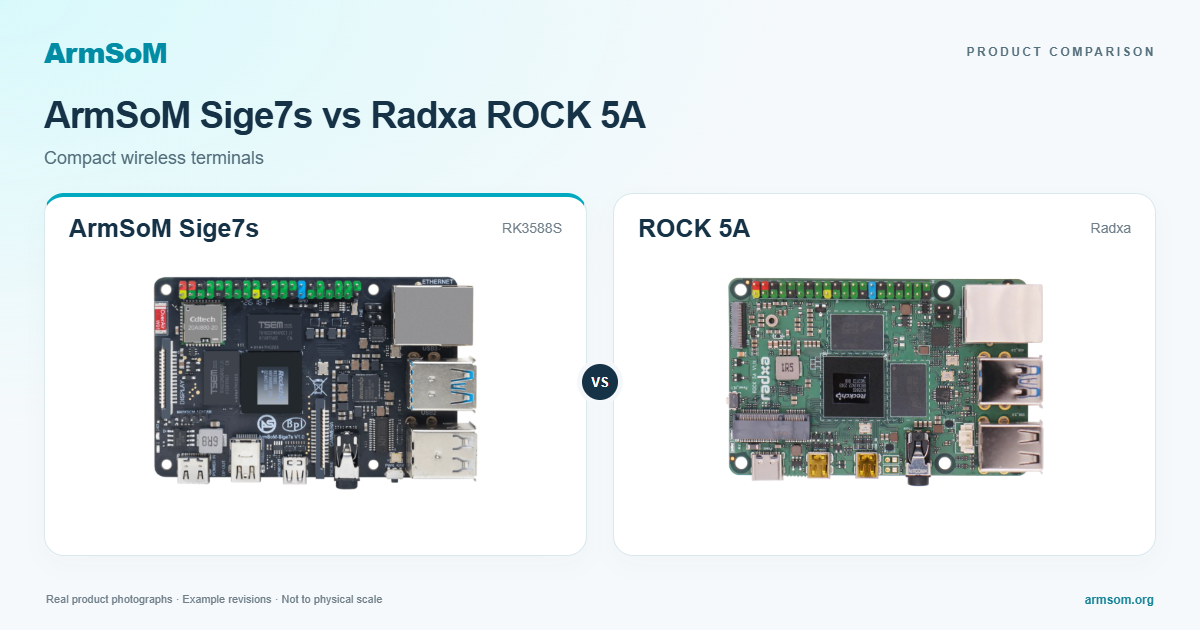
Product photos: ArmSoM; Radxa. Whole boards, independently fitted and not shown to physical scale. The comparison does not imply a partnership between the brands.
Specifications at a glance
Design factor | ArmSoM Sige7s | Radxa ROCK 5A |
Процессор | RK3588S | RK3588S |
PCB footprint | 85 × 56 mm | 85 × 56 mm |
Ethernet | 1 × Gigabit Ethernet | 1 × Gigabit Ethernet |
Беспроводная связь | Onboard Wi-Fi 6 + Bluetooth | M.2 E-key for an optional wireless module |
External displays | HDMI + USB-C DisplayPort | 2 × micro-HDMI |
Camera connection | 2-lane MIPI CSI; documented up to 5 MP | 4-lane MIPI CSI, configurable as 2 × 2-lane |
Storage expansion | microSD and eMMC module | microSD and eMMC module; separate PCIe expansion options |
What Sige7s simplifies in a connected terminal
A compact terminal may need only one display, a wireless connection and several USB peripherals. Sige7s includes the Wi-Fi radio on the board, so the starting configuration does not need a separate M.2 Wi-Fi module. That can simplify the purchasing list and leave fewer separately selected parts to qualify.
The radio still needs an appropriate antenna installation. Metal housings, antenna placement and nearby cables affect connectivity. Test the terminal in its final enclosure and compare reconnect behaviour after an access-point restart. An onboard radio reduces assembly choices; it does not guarantee wireless range.
Choose the display connectors before choosing the case
Sige7s exposes HDMI and DisplayPort through USB-C. This arrangement suits a product whose second display already accepts a compatible USB-C or DisplayPort connection. ROCK 5A provides two micro-HDMI outputs, which may be easier when both displays use HDMI.
Count adapters, connector strain relief and cable routing in the enclosure. The boards share an 85 × 56 mm footprint, but that does not make their port positions, mounting clearances, cooling hardware or cases interchangeable. Sige7s has a confirmed overall size of 85 × 56 × 17 mm; the complete installation also needs space for cables and cooling.
For an embedded panel, inspect the DSI connector and the supported panel configuration. Sige7s documents a two-lane DSI connection with a 1280 × 800 display limit. Do not infer that any panel supported on ROCK 5A will work on Sige7s because both boards belong to the RK3588S family.
Camera requirements may favour ROCK 5A
Radxa documents a four-lane CSI connection that can be configured as two two-lane interfaces. Sige7s documents a two-lane camera connection with support up to 5 MP. If the project depends on a wider camera interface, start with the camera module, driver and capture mode, then choose the board.
This distinction matters more than the shared 6 TOPS NPU headline. The NPU only receives useful work after the camera and preprocessing pipeline are functioning. A supported model on one board does not establish support for the same camera sensor on another.
Moving an application without carrying over board assumptions
Application code is often the most reusable part of a migration. Boot configuration, GPIO assignments, display settings and kernel modules need a separate review. Install the target board's image, confirm the peripherals, and then deploy the application with its runtime dependencies recorded.
For a kiosk, test display wake-up, touch input, Wi-Fi reconnect, audio and unattended restart. For a desktop-style terminal, test both displays at the intended mode while USB peripherals are active. Keep the same application build and workload when comparing response time.
A practical buying decision
Sige7s fits a compact connected terminal that benefits from onboard wireless and HDMI plus USB-C display connectivity. ROCK 5A remains a useful choice when two micro-HDMI outputs, its camera arrangement or a selected M.2 radio are central to the design.
Ask for the complete configuration: memory, eMMC module, antennas, power supply and cooling. Neither board is assigned a price or performance advantage without a matched quotation or measurement. The ArmSoM advantage in this comparison is a particular set of integrated connections, not a blanket claim about the RK3588S.
Questions before you choose
Is Sige7s a mechanical replacement for ROCK 5A?
The PCB footprint is similar, but connector placement and assembly clearances must be checked. Existing enclosures and accessories are not assumed compatible.
Does Sige7s use the full RK3588?
No. Sige7s uses RK3588S. ArmSoM Sige7 uses RK3588 and has a different network and storage layout.
Evaluate ArmSoM Sige7s for your application
Check your required interfaces, software image, memory and storage configuration before choosing a prototype. Explore ArmSoM Sige7s и read the hardware documentation.
References and comparison method
Published by ArmSoM. This guide compares manufacturer specifications checked on 25 November 2026. Recommendations reflect the documented interfaces and application requirements; this is not a hands-on benchmark or a compatibility certification.