

Choose the video source before the board. Orange Pi 5 Ultra includes HDMI input, which is useful when the source is another device’s HDMI output. ArmSoM Sige7 has two 2.5GbE ports and can suit a vision appliance that separates camera traffic from an upstream network. Sige7 does not provide onboard HDMI capture.
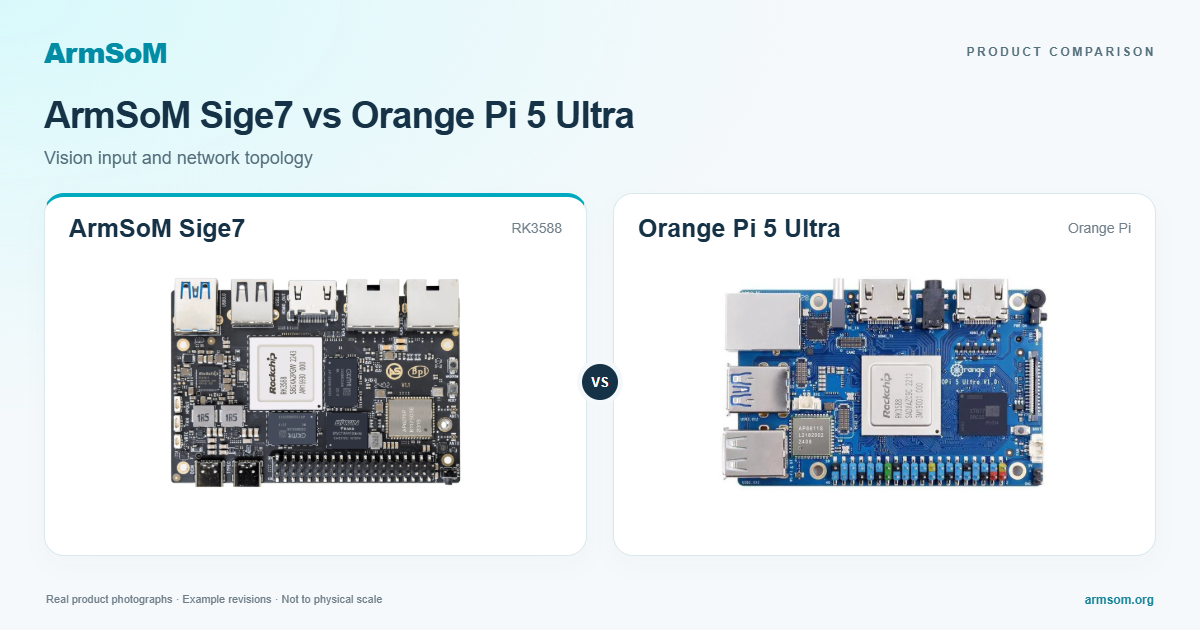
Product photos: ArmSoM; Orange Pi product photo via CircuitPython. Whole boards, independently fitted and not shown to physical scale. The comparison does not imply a partnership between the brands.
Specifications at a glance
Design factor | ArmSoM Sige7 | Orange Pi 5 Ultra |
Процессор | RK3588 | RK3588 |
Вход HDMI | Not fitted | HDMI input, documented up to 4K60 |
Ethernet | 2 × 2.5GbE | 1 × 2.5GbE |
NVMe | PCIe 3.0 ×4 M.2 | PCIe 3.0 ×4 M.2 |
Семья памяти | LPDDR4 / LPDDR4x | LPDDR5 |
Camera expansion | MIPI CSI connections; sensor/driver validation required | MIPI CSI and D-PHY RX connections; sensor/driver validation required |
Selection focus | Two wired networks and local processing | HDMI capture and local processing |
HDMI output and HDMI input are different requirements
A board that can display a high-resolution picture cannot necessarily capture one from another device. Orange Pi 5 Ultra documents HDMI input as well as output. That makes it relevant for receiving a video feed from equipment with an HDMI source.
Sige7 does not have an HDMI input. An external capture device would add a separate compatibility, bandwidth and latency problem. If built-in HDMI capture is mandatory, Orange Pi 5 Ultra deserves direct evaluation. Do not choose Sige7 based on its decoder or display specifications and assume those blocks create an input connector.
Where Sige7 fits a vision appliance
Many vision systems obtain images through network cameras or supported MIPI sensors. For a network-camera design, Sige7's two 2.5GbE ports allow camera-side traffic and upstream communication to use separate physical links. The board can process local data and transmit selected results without placing both connections on one RJ45 port.
This arrangement still needs a network plan. Camera power may come from an external PoE switch or another supply; two Ethernet ports do not imply PoE output. The application must also handle stream reconnects, timestamps and periods when the upstream network is unavailable.
Plan the capture-to-result pipeline
Define the source, resolution, frame rate and pixel format first. Then account for decode or capture, resizing, inference, postprocessing and display. If recording is required, add encoding and storage to the same workload rather than testing them in isolation.
The shared RK3588 NPU headline does not establish how many camera streams either finished system can process. Operator support, model quantisation, memory copies and the video path can be decisive. Measure end-to-end latency from an input frame to the result that the application uses.
Storage and memory deserve separate checks
Both boards provide PCIe 3.0 ×4 NVMe connectivity. That gives either design a path to local recording, but the selected SSD must sustain the intended writes within the enclosure. Use a bounded retention policy and test what happens when the drive approaches capacity.
Orange Pi 5 Ultra's LPDDR5 is a documented difference from Sige7's LPDDR4/LPDDR4x. Memory-bound video work may respond differently, so use the same camera workload and comparable RAM capacity in an evaluation. Avoid borrowing performance figures from another Orange Pi 5 model or from an RK3588 development kit.
Run failure tests before selecting a deployment board
For the Sige7 network-camera scenario, disconnect the upstream cable while camera input continues. Verify that recording and local decisions behave as intended, then restore the connection and inspect recovery. Repeat with the camera connection interrupted.
For Orange Pi 5 Ultra HDMI capture, test source reconnects, mode changes and the actual capture software. A listed maximum mode does not guarantee every source, colour format or protected content path will work. These tests should use the production image and the final thermal arrangement.
Sige7's strongest case here is a dual-network vision computer with local storage. Orange Pi 5 Ultra's strongest case is a system that needs the HDMI input already on the board. Choosing by input topology keeps a useful comparison from turning into an unsupported general performance ranking.
Questions before you choose
Can Sige7 capture HDMI directly?
No onboard HDMI input is documented for Sige7. Its HDMI output should not be confused with an input.
Does dual Ethernet mean Sige7 powers IP cameras?
No. Plan camera power separately, for example with a suitable PoE switch. The Ethernet-port count does not establish PoE output capability.
Evaluate ArmSoM Sige7 for your application
Check your required interfaces, software image, memory and storage configuration before choosing a prototype. Исследуйте ArmSoM Sige7 и read the hardware documentation.
References and comparison method
Published by ArmSoM. This guide compares manufacturer specifications checked on 25 November 2026. Recommendations reflect the documented interfaces and application requirements; this is not a hands-on benchmark or a compatibility certification.