

ArmSoM Sige5 is worth shortlisting when an RK3576 system needs two wired networks and an internal NVMe drive. ROCK 4D offers a smaller conventional SBC layout, LPDDR5 memory and more USB connectivity. The deciding factor is how the board connects to the rest of your product.
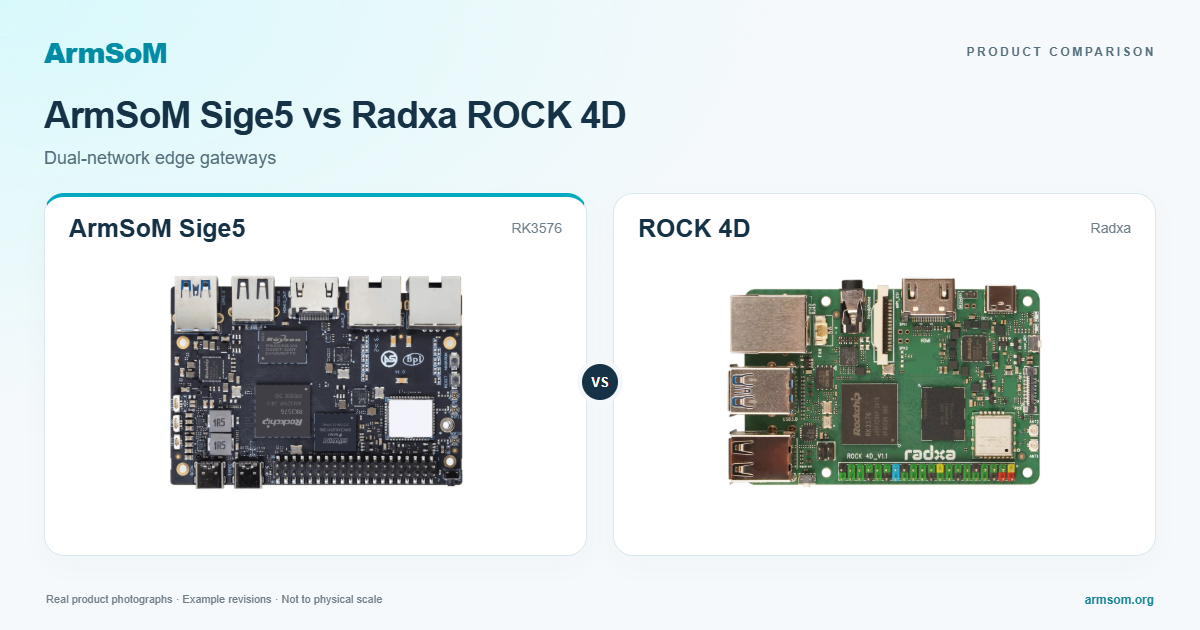
Product photos: ArmSoM; Radxa. Whole boards, independently fitted and not shown to physical scale. The comparison does not imply a partnership between the brands.
Specifications at a glance
Design factor | ArmSoM Sige5 | Radxa ROCK 4D |
处理器 | RK3576 | RK3576; RK3576J industrial variant also listed |
Wired networks | 2 × 千兆以太网 | 1 × Gigabit Ethernet |
记忆家族 v1 上 | LPDDR4 / LPDDR4x | LPDDR5 |
NVMe connection | M.2 M-key, PCIe 2.1 ×1 | PCIe 2.1 ×1 through FPC; SSD adapter required |
无线 | Onboard Wi-Fi 6 + Bluetooth | Onboard Wi-Fi 6 + Bluetooth |
USB emphasis | USB 2.0; Type-C OTG | 2 × USB 3.0 Type-A + 2 × USB 2.0 Type-A |
Why a second Ethernet port can change the design
A gateway between equipment and a building network needs a clear connection plan. Sige5 puts two Gigabit Ethernet ports on the board, so the equipment side and upstream side can use separate cables without a USB Ethernet adapter. This is a useful ArmSoM advantage for a data collector, local monitoring server or compact automation controller.
Two physical ports do not create a secure gateway by themselves. Routing, firewall rules, service binding and update policy still belong in the software design. They do, however, let you build that design around two native board connectors. ROCK 4D's single Ethernet port suits a device on one wired network, including a terminal that communicates through an existing managed network.
Storage: the same lane count, different installation
Sige5 has an M.2 M-key socket for an NVMe SSD. ROCK 4D brings PCIe out through an FPC connector, so an SSD installation needs a suitable adapter and cable. Both documented paths use one PCIe 2.1 lane. Sige5's benefit here is the physical installation, not a claim of a faster PCIe generation.
For a gateway that stores events, keep the operating system and data-retention plan separate. Decide whether the application boots from eMMC or another supported medium, how much logging goes to the SSD, and what happens when storage fills. Confirm the SSD length, mounting hardware and enclosure clearance before ordering the production configuration.
Where ROCK 4D deserves a closer look
ROCK 4D has LPDDR5 memory and two USB 3.0 Type-A connections. Those are meaningful differences for applications using fast USB peripherals. Sige5's documented USB connections are USB 2.0, so a high-bandwidth USB camera or external drive can make ROCK 4D the more appropriate starting point. An onboard NVMe socket cannot compensate for a bottleneck on a separate USB data path.
Radxa also lists an RK3576J industrial variant with a wider specified temperature range. Compare the exact grade being quoted; do not transfer the industrial version's rating to every ROCK 4D. Similarly, choosing a Sige5 for industrial equipment does not by itself establish a particular environmental certification.
Evaluate the complete gateway workload
Both platforms use the RK3576 family and advertise a 6 TOPS NPU. That does not establish equal inference latency or a performance winner. For a vision gateway, convert the intended model, connect the supported camera, and measure capture, preprocessing, inference and result delivery together.
A useful acceptance run keeps both Ethernet links active while recording to storage and running the application. Record packet loss, storage latency, CPU load and temperature. Repeat after a cold boot and an interrupted network connection. If the appliance will use encryption, include it in the run instead of relying on an unencrypted transfer result.
When to choose Sige5
Choose Sige5 for evaluation when two physical network connections and a directly mounted SSD are more useful than extra USB 3.0 ports. Its onboard Wi-Fi 6 can also provide a separate wireless connection, subject to the selected image, antenna installation and operating mode.
For a single-network device with fast USB peripherals or a requirement for Radxa's industrial variant, compare those ROCK 4D features directly against the product requirements. Price the whole assembly, including the SSD adapter, power supply, antennas and cooling. Board-only prices leave out the parts that often decide the enclosure and assembly cost.
Questions before you choose
Does Sige5 have faster AI than ROCK 4D?
No comparative benchmark is established here. Both use the RK3576 family; measure the actual model with the selected memory, image and cooling.
Can I move a ROCK 4D disk image directly to Sige5?
Use an image built for Sige5. Shared silicon does not make the bootloader, device tree or peripheral configuration interchangeable.
Evaluate ArmSoM Sige5 for your application
Check your required interfaces, software image, memory and storage configuration before choosing a prototype. Explore ArmSoM Sige5 和 read the hardware documentation.
References and comparison method
Published by ArmSoM. This guide compares manufacturer specifications checked on 25 November 2026. Recommendations reflect the documented interfaces and application requirements; this is not a hands-on benchmark or a compatibility certification.