

An Orange Pi 5 Max alternative should solve a specific design problem. For an edge server that needs two separate wired networks, Sige7 provides two built-in 2.5GbE ports alongside a PCIe 3.0 ×4 NVMe connection. Orange Pi 5 Max is a strong candidate for a single-network RK3588 system with LPDDR5 memory.
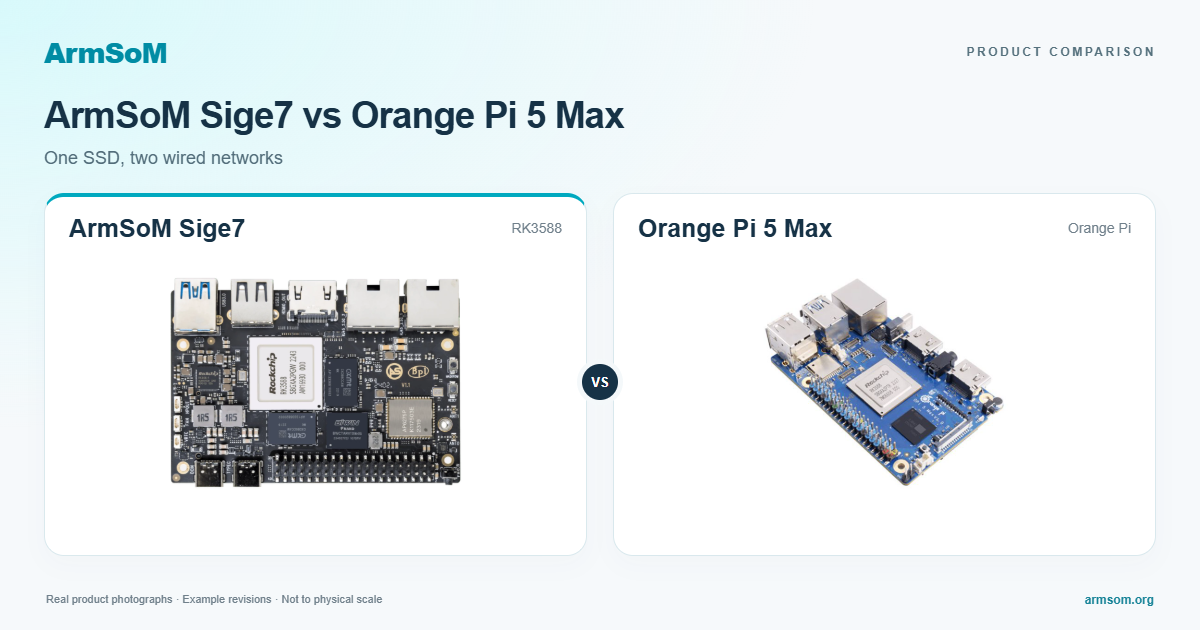
Product photos: ArmSoM; Orange Pi product photo via CircuitPython. Whole boards, independently fitted and not shown to physical scale. The comparison does not imply a partnership between the brands.
Specifications at a glance
Design factor | ArmSoM Sige7 | Orange Pi 5 Max |
处理器 | RK3588 | RK3588 |
NPU headline | Up to 6 TOPS | Up to 6 TOPS |
以太网 | 2 × 2.5GbE | 1 × 2.5GbE |
NVMe connection | M.2, PCIe 3.0 ×4 | M.2, PCIe 3.0 ×4 |
记忆家族 v1 上 | LPDDR4 / LPDDR4x | LPDDR5 |
无线 | Onboard Wi-Fi 6 | Onboard wireless; confirm module revision |
Two network ports serve a different product layout
Imagine an edge server that collects data from local equipment and sends selected results to another network. Sige7 lets the two connections terminate directly on the board. That can eliminate an external USB Ethernet adapter and its mounting, cable and driver-management requirements.
Orange Pi 5 Max has one 2.5GbE connection. A system on one network may need nothing more. Some designs can also use VLANs through a managed switch, but that is a network architecture decision. Two native ports remain useful when the requirement calls for separate physical cables or interfaces.
The ArmSoM advantage is therefore specific: integrated dual-network hardware. It is not a claim that Sige7 is inherently faster at every server task.
NVMe alone does not distinguish these boards
Both boards expose a four-lane PCIe 3.0 connection for NVMe storage. Either can be considered for a local database, application files or recorded data, subject to the chosen SSD and software. There is no reason to describe SSD support as exclusive to Sige7.
For a write-heavy service, measure latency as well as sequential transfer rate. Database synchronisation, metadata operations and retention jobs can stress a drive differently from a large file copy. Include temperature monitoring and the actual filesystem. Confirm how the selected image boots and how the system can be recovered without dismantling the appliance.
Memory is a real Orange Pi distinction
Orange Pi 5 Max uses LPDDR5; Sige7's documented memory is LPDDR4/LPDDR4x. A memory-sensitive application should take that difference seriously. It does not, on its own, provide a percentage improvement for a database, container service or AI pipeline.
Choose enough RAM for the running application, buffers and expected growth, then test memory pressure with the intended services active. Compare equal-capacity configurations where available. A large difference in RAM capacity can dominate the practical result even when the processor name is identical.
Local AI needs more than a TOPS figure
Both boards use the RK3588 platform and advertise a 6 TOPS NPU. To evaluate an inference service, use the same model, conversion settings, input resolution and preprocessing. Record the runtime version and whether unsupported operations fall back to the CPU.
Measure request latency while the machine is also writing logs and transferring results. A camera-to-result pipeline has work outside the NPU, and concurrent network and storage activity may change its behaviour. These measurements are more useful than comparing a synthetic number from an unrelated software image.
Which design should start with Sige7?
Sige7 fits an appliance that needs one internal SSD, two fast wired connections and onboard wireless. That includes a local processing server with separate equipment and management networks, provided the software and security design support that arrangement.
For a single-network desktop or server, Orange Pi 5 Max's LPDDR5 configuration may be a better match. Compare the complete purchase, including memory, boot storage, power supply, antennas and cooling, before assigning a cost advantage. If moving an existing Orange Pi application to ArmSoM, retain the application requirements but install the correct Sige7 image and revalidate its peripherals.
Questions before you choose
Is Sige7 a drop-in replacement for Orange Pi 5 Max?
It is an alternative board for a new or revised design. Enclosure, power, boot image and peripheral compatibility require validation.
Does Sige7 offer a faster NVMe interface?
Both documented configurations use PCIe 3.0 ×4 for NVMe. This comparison identifies Sige7’s second Ethernet port as the main connectivity difference.
Evaluate ArmSoM Sige7 for your application
Check your required interfaces, software image, memory and storage configuration before choosing a prototype. 探索ArmSoM Sige7 和 read the hardware documentation.
References and comparison method
Published by ArmSoM. This guide compares manufacturer specifications checked on 25 November 2026. Recommendations reflect the documented interfaces and application requirements; this is not a hands-on benchmark or a compatibility certification.