

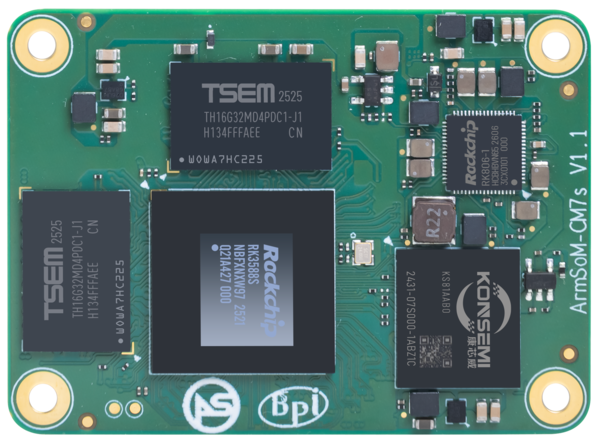
ArmSoM CM7s product photograph.
Choosing an RK3588S SoM module is about more than CPU cores and AI capability. The way the module connects to its carrier affects assembly, prototype changes, repair and the cost of bringing a product into production.
ArmSoM CM7s, Firefly Core-3588SG and Boardcon CM3588S all use RK3588S, but they take different approaches to integration. CM7s uses removable board-to-board connectors. Core-3588SG uses a BGA371 solder-down interface, while CM3588S is described by Boardcon as a 196-pin QFN module.
CM7s offers a connector-based approach for teams assembling and servicing their own carrier-board products. Compare current quotations for equivalent memory, storage and order quantities, together with assembly and service costs, before making a purchasing decision.
RK3588S module comparison at a glance
Параметр | ArmSoM CM7s | Firefly Core-3588SG | Boardcon CM3588S |
Процессор | Rockchip RK3588S | Rockchip RK3588S | Rockchip RK3588S |
Module connection | 3 × 100-pin BTB connectors | BGA371 solder-down interface | 196-pin, 1.0 mm pitch QFN package |
Module outline | 55 × 40 mm | 50 × 50 mm | 57.5 × 45 mm |
Final module installation | Mate to carrier connectors and secure mechanically | Solder module to carrier | Solder module to carrier |
Module replacement | Disconnect with power removed, after releasing retention hardware | Requires a suitable solder-rework process | Requires a suitable solder-rework process |
Commercial comparison | Request a quote for the exact configuration and quantity | Compare the same configuration and quantity | Request a matching configuration quote |
Connection types and dimensions come from the manufacturers' linked product information. The assembly and replacement implications are engineering analysis of those connection types, rather than measured assembly-time or yield results.
Why CM7s uses a BTB connection
BTB means board-to-board, also commonly written B2B. On CM7s, three connectors provide the mechanical and electrical link to a compatible carrier. The carrier's mating connectors are soldered during its PCB assembly; the compute module can then be installed as a separate assembly step.
This separation is useful when the carrier contains product-specific power, networking, camera or control circuitry. The team can assemble and inspect that carrier before attaching the compute module. It also supports a workflow in which a known-good module is used to evaluate a new carrier revision.
For a small production run, this can reduce dependence on module-level reflow and rework equipment during final integration. For a serviceable product, it gives the designer a way to replace the compute assembly without desoldering it from the carrier.
CM7s versus Firefly Core-3588SG
Firefly specifies a BGA371 interface for Core-3588SG. That makes the module attachment part of the soldering process. A manufacturer using this approach should plan placement, reflow, inspection and rework around the module package.
CM7s offers a different production sequence: assemble the carrier and its connectors, inspect it, then install and secure the module. If a prototype needs another carrier revision, the compute module can be moved after power is removed and the retention hardware is released.
A solder-down approach can still fit a product designed around a fixed assembly and an established manufacturing process. The CM7s advantage is most relevant when modular assembly, repeated carrier development or replacement access matters to the product team.
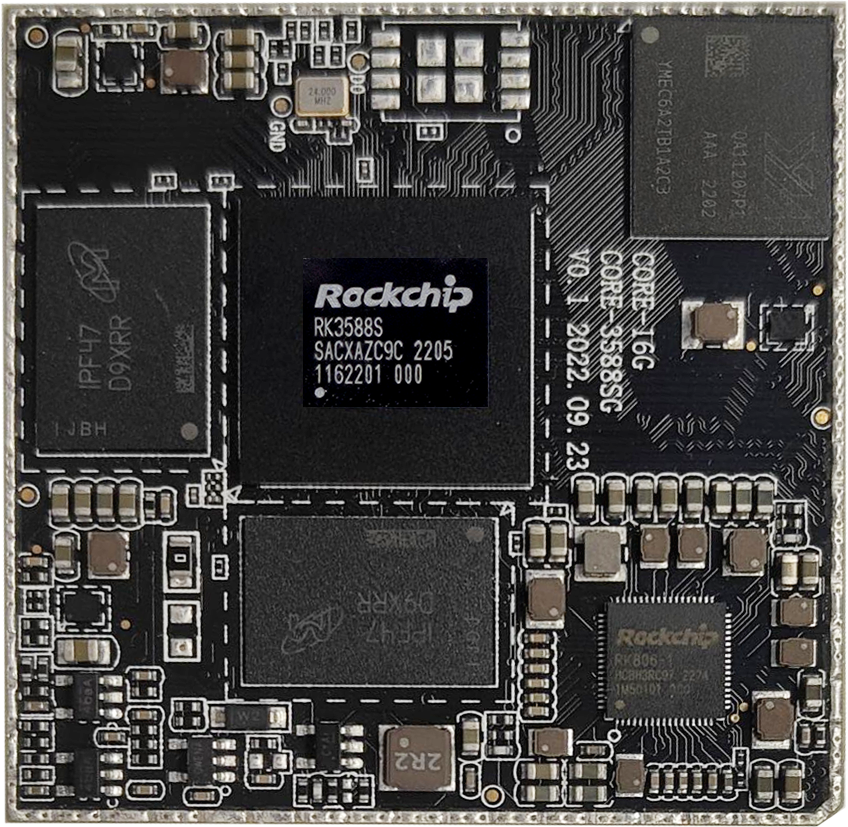
Firefly Core-3588SG, front view. Official product photograph from Firefly; shown for module comparison. Image: Firefly.
CM7s versus Boardcon CM3588S
Boardcon's CM3588S documentation identifies a 196-pin QFN package. The pin count describes its module interface; it should not be read as a removable 196-pin socket.
For a team building a custom terminal or edge device, CM7s provides a connector-based alternative. The module and carrier remain separable assemblies, making it practical to investigate a suspected carrier fault by testing with a known-good module, or vice versa.
The modules have different footprints, power requirements and pin assignments. Moving from CM3588S to CM7s requires a compatible carrier design and a software review. The opportunity is a different integration architecture, with the associated assembly and service benefits.
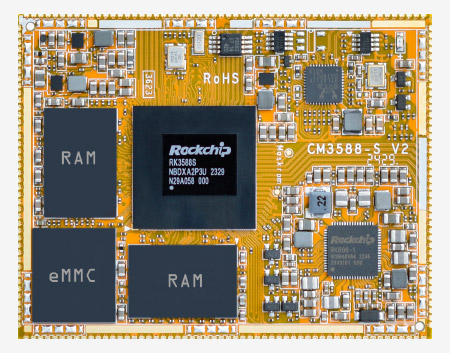
Boardcon CM3588S, front view. Official product photograph from Boardcon; shown for module comparison. Image: Boardcon.
Compare module price and total product cost
CM7s uses an assembly method that can simplify module installation and replacement. Evaluate the quoted module price and the complete integration cost together.
For a fair quotation, specify RAM, eMMC, temperature requirements, quantity, delivery destination and whether the offer includes a carrier or accessories. A store listing that mixes an IO board, module and development kit can show an entry price that does not represent the compute module you need.
Then include carrier connectors, retention hardware, assembly labor, test fixtures and expected repair work. BTB connectors add parts and stack height; they can also avoid solder rework when the compute assembly needs replacement. The resulting cost balance depends on the product and manufacturing process.
Check these details before designing your carrier
Use the current CM7s documentation and drawings to select the correct mating connectors, stacking height and mechanical support. Route required interfaces against the module pinout and account for multiplexed functions. Confirm that the camera, display, storage and network connections can operate together.
Provide a defined assembly method with power removed, correct alignment and even insertion force. Add retention suitable for the enclosure and expected mechanical environment. A removable connector does not establish hot-swap support or unlimited mating cycles.
Validate the application on the intended ArmSoM image and carrier configuration. Sharing an RK3588S processor does not make another manufacturer's boot image or peripheral configuration interchangeable.
Common questions
Does CM7s avoid all soldering?
The carrier and its mating connectors still need PCB assembly. The difference is that attaching or replacing the compute module itself uses connectors rather than soldering the module onto the carrier.
Is CM7s a drop-in replacement for either module?
No. The physical interfaces differ. Evaluate CM7s with a compatible carrier and review power, pin assignments, mechanics and software for your product.
Will the three modules perform identically?
The shared processor is a useful starting point, but memory configuration, cooling, software and workload affect results. Compare your application under equivalent conditions before making a performance claim.
Choose CM7s when assembly flexibility matters
For an RK3588S product that needs a competitive module price, separable carrier assembly and a practical replacement path, CM7s belongs on the shortlist. Its BTB design gives engineering and manufacturing teams flexibility throughout prototype development, pilot production and service.
Explore ArmSoM CM7s, review the technical documentation, or send your memory, storage, carrier requirements and estimated quantity to sales@armsom.org for a matching quotation.
Revision check: The current Документация CM7s flags CN2 pins 2 and 4 on v1.1 as non-functional and describes a correction planned for v1.2. Confirm the revision supplied and its pinout before completing a carrier review.