

ArmSoM Sige7 brings two built-in 2.5GbE ports, Wi-Fi 6 and a PCIe 3.0 ×4 NVMe connection to a compact 92 × 62 mm RK3588 board. That combination makes it a useful ROCK 5B+ alternative for gateways and connected edge appliances. Here is how the network, storage and display layouts compare.
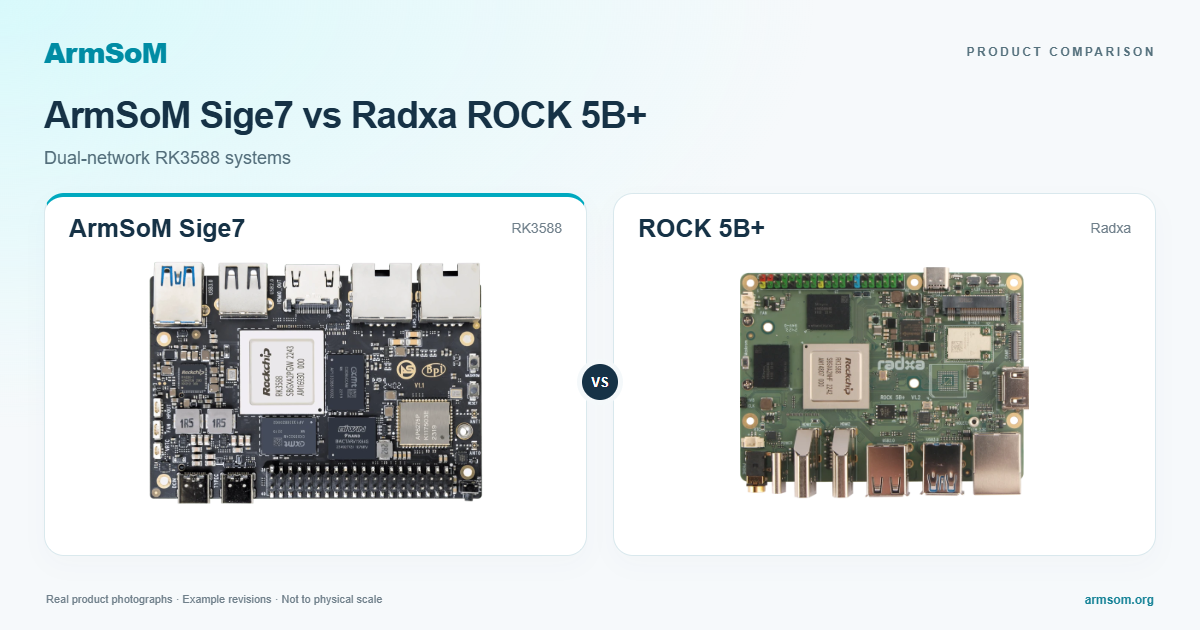
Product photographs: ArmSoM; Radxa. Example hardware revisions are shown independently fitted, not to physical scale. The comparison does not imply a partnership between the brands.
Specifications at a glance
Design question | ArmSoM Sige7 | Radxa ROCK 5B+ |
Процессор | RK3588 | RK3588 |
Board footprint | 92 × 62 mm | 100 × 75 mm |
Ethernet | 2 × 2.5GbE | 1 × 2.5GbE |
NVMe topology | 1 × M.2, PCIe 3.0 ×4 | 2 × M.2, each PCIe 3.0 ×2 |
Семья памяти | LPDDR4x | LPDDR5 |
Беспроводная связь | Wi-Fi 6 + Bluetooth 5 | Wi-Fi 6 + Bluetooth 5.2 |
Display emphasis | HDMI, USB-C DisplayPort, MIPI DSI | Multiple outputs plus HDMI input |
Start with the network and storage topology
A small edge server often needs two physically separate network connections: one for equipment and one for the upstream network. Sige7 supplies those connections on the board. That can remove an external USB Ethernet adapter, its cable and another component that needs mounting inside the enclosure. It is a practical integration advantage for a gateway, inspection station or local data collector.
ROCK 5B+ offers a different allocation of space and interfaces. Radxa documents two M.2 M-key sockets, each with two PCIe 3.0 lanes. Sige7 has one four-lane socket. Two sockets help when a design calls for separate system and data drives; one wider connection is useful when the design calls for a single NVMe drive. Neither arrangement proves a particular sustained transfer rate.
The connector counts and lane allocation above come from the ROCK 5B+ product page и Документация Sige7. The comparison is specifically with 5B+, whose storage layout differs from the original ROCK 5B.
Where Sige7 has a useful advantage
A smaller board with both network ports already fitted
Sige7 takes less PCB area while retaining two 2.5GbE connectors, onboard wireless and NVMe expansion. For a compact networked product, that combination can simplify the enclosure layout. Plan the cable bend radius, SSD position and cooling space as well: a smaller PCB does not automatically make the finished assembly smaller.
An established ArmSoM development path
ArmSoM provides the Sige7 hardware guide, software-image resources and interface instructions in one documentation system. Teams already working with ArmSoM can use that familiar starting point to bring up the network, storage and application together.
Storage and video connections to check
ROCK 5B+ provides two internal SSD sockets and HDMI input. Its LPDDR5 memory is another specification difference. Sige7 concentrates on two native network ports and a single four-lane NVMe connection; map these layouts to the actual data path in the product.
Both boards include Wi-Fi 6. Sige7 combines this with a second native 2.5GbE port on a smaller PCB, which is the relevant distinction for a wireless-enabled dual-network appliance.
A realistic evaluation for an edge server
For a two-network appliance with one SSD, evaluate Sige7 first. Connect both production networks, run the actual service, and copy data to the SSD while monitoring temperature and link stability. Measure application throughput with encryption and filtering enabled if those functions will be used. A 2.5GbE link rate is not a firewall-throughput guarantee.
If the product requires HDMI capture or two internal SSDs, include those requirements in the design review. Sige7 has one onboard NVMe socket and no HDMI input; its main fit in this comparison is a compact networked system with one SSD.
Compare the complete purchase
Request quotes for equal RAM, boot storage and cooling requirements. Add the power supply, antennas, case, SSD and any network adapter. Neither brand is assigned a price advantage here because a current like-for-like quotation has not been established. The useful question is which board eliminates the most additional hardware in your particular design.
Часто задаваемые вопросы
Is Sige7 faster than ROCK 5B+?
This comparison does not establish a benchmark winner. They share RK3588, while memory, cooling, software and peripheral use differ.
Does Sige7 replace a ROCK 5B+ enclosure?
No mechanical compatibility is established. Board dimensions and connector positions differ; design the enclosure around the chosen board.
Evaluate ArmSoM Sige7 for your product
Send ArmSoM your required RAM, storage, interfaces, operating system and expected volume. Start with the product and hardware guide below to discuss an appropriate sample configuration.
Sources and comparison method
Published by ArmSoM. This selection guide compares documented hardware features; it is not a head-to-head benchmark. References reviewed on 23 November 2026. Confirm the supplied revision, configuration and software support when ordering.