

ArmSoM LM7 is a 45 × 50 mm RK3588 LGA module with 506 contacts. FriendlyELEC CM3588 uses four 100-pin board-to-board connectors and has a ready-made NAS carrier option. LM7 fits a custom soldered assembly; CM3588 suits a removable module or a project built around its carrier ecosystem.
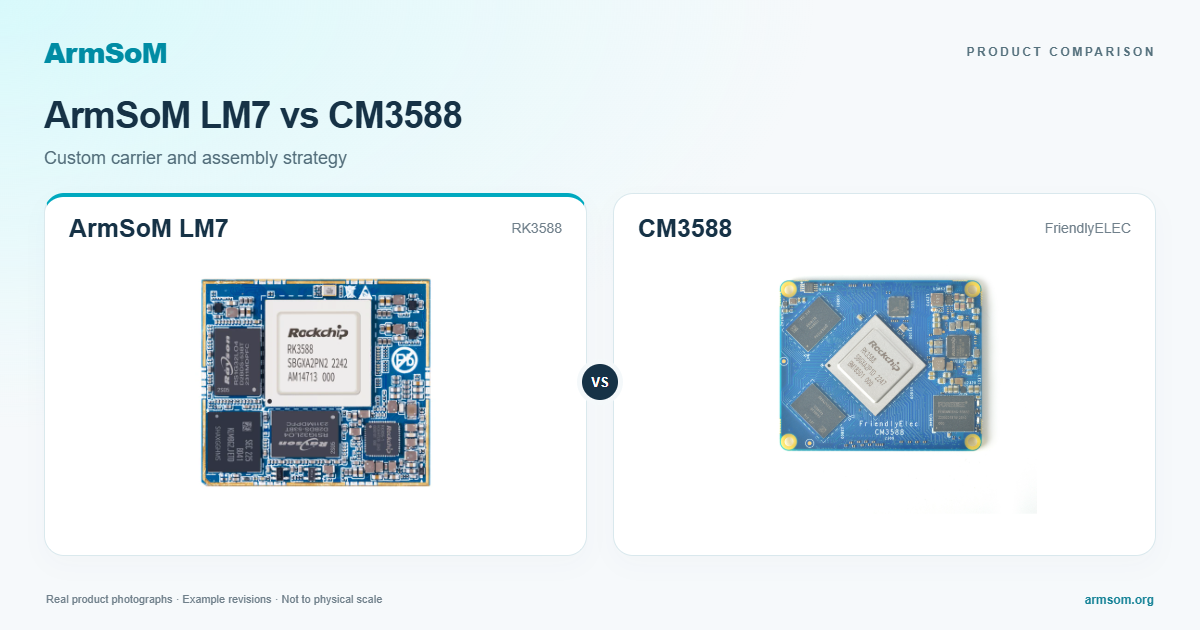
Product photos: ArmSoM; FriendlyELEC. Whole boards, independently fitted and not shown to physical scale. The comparison does not imply a partnership between the brands.
Specifications at a glance
Design factor | ArmSoM LM7 | FriendlyELEC CM3588 |
Процессор | RK3588 | RK3588 |
Module attachment | 506-contact LGA, soldered to carrier | 4 × 100-pin board-to-board connectors |
Module footprint | 45 × 50 mm | 55 × 65 mm for CM3588; Plus differs |
Carrier starting point | W3 development kit and LM7 design resources | CM3588 NAS Kit carrier |
Field module removal | Requires appropriate rework process | Connector-mounted module can be removed |
Application I/O | Carrier design determines fitted ports | Carrier design determines fitted ports |
Migration | New carrier/assembly validation required | Not electrically or mechanically interchangeable with LM7 |
Choose the assembly method early
A system-on-module decision affects the carrier board, factory process and service strategy. LM7 uses an LGA interface that is soldered to the carrier. CM3588 uses four 100-pin connectors. They are not interchangeable modules, even though both contain an RK3588 processor.
LM7's smaller module footprint is useful when the product needs a custom board with tightly controlled connector placement. A soldered module can form part of a compact integrated assembly. The actual height and board area still depend on carrier routing, components, keep-outs and cooling.
CM3588's connector arrangement supports removing the module without desoldering it. That can matter for prototype iteration, repair strategy or product variants. The final assembly still needs retention, clearance and a suitable connector specification.
What LM7 offers a custom product team
ArmSoM documents LM7's module signals and provides a W3 development-kit path. A team can evaluate the processor and application, then design a carrier around the required external connectors. This is useful for an embedded terminal whose enclosure cannot accommodate the port arrangement of a general-purpose SBC.
The 506-contact LGA interface gives the carrier designer access to a broad signal set. Treat those contacts as design resources, not as 506 independent GPIOs. Many functions share pins or PHY resources. A valid carrier design assigns those resources according to the module documentation and the chosen operating mode.
Compare modules separately from carrier boards
FriendlyELEC's CM3588 NAS Kit has a carrier designed for multiple NVMe drives. That makes it a useful starting point for a storage prototype. The carrier's SSD sockets, Ethernet connector and display ports should not be described as connectors physically fitted to every CM3588 module.
The same rule applies to LM7 and W3. A W3 connector list is not a guarantee that a new LM7 carrier exposes the same ports. Build the comparison in two stages: module resources first, then the carrier's routing, power design and fitted connectors.
This article compares the standard CM3588 module. CM3588 Plus is a separate revision with different mechanical details. Use the drawing and pinout for the exact module in the quotation.
LGA integration brings manufacturing work
A soldered module needs a suitable PCB land pattern, assembly profile, inspection process and repair procedure. Discuss those requirements with the assembly team before freezing the carrier. Rework access and production test points should be designed into the product.
Connector-based assembly avoids soldering the module itself, but adds mating connectors and their mechanical requirements. Neither approach is inherently cheaper for every volume or more reliable in every environment. Compare the actual bill of materials, assembly yield, test time and expected service process.
Qualify the product through the development kit
Use the development platform to bring up the application and confirm required software support. Record the memory configuration, boot storage, kernel, runtime and peripheral drivers. When moving to the custom carrier, repeat the checks affected by power, pin multiplexing, signal routing and connectors.
For an AI terminal, validate the camera-to-result path. For a multi-drive storage product, validate the lane arrangement and simultaneous drive access. A successful application on a development kit does not finish the electrical validation of a new carrier.
Choose LM7 for evaluation when a smaller soldered RK3588 module and a custom carrier are central to the product. Choose CM3588 when removable module assembly or its NAS carrier is more valuable. The deciding advantage is the fit with the manufacturing and service plan, not a claim that one RK3588 implementation is universally faster.
Questions before you choose
Can LM7 plug into a CM3588 NAS carrier?
No. LM7 uses a soldered LGA interface; CM3588 uses board-to-board connectors. A different carrier design is required.
Does LM7 have four NVMe sockets?
LM7 is a module, not a NAS carrier. SSD connectors and lane allocation are determined by the carrier design.
Evaluate ArmSoM LM7 for your application
Check your required interfaces, software image, memory and storage configuration before choosing a prototype. Explore ArmSoM LM7 и read the hardware documentation.
References and comparison method
Published by ArmSoM. This guide compares manufacturer specifications checked on 25 November 2026. Recommendations reflect the documented interfaces and application requirements; this is not a hands-on benchmark or a compatibility certification.