

ArmSoM Zero5 is a planned RK3572-based single-board computer for developers looking at compact Linux and edge-AI hardware. If you are researching a Raspberry Pi Zero 3 W alternative, Zero5 is a project to follow—especially when local inference and a small footprint are part of the brief.
The proposed footprint is 65 × 30 mm. Its RK3572 processor combines eight CPU cores with a dedicated NPU and multimedia hardware. Final board specifications and availability are still pending, so this is a design preview rather than a claim that Zero5 can replace a Raspberry Pi board without changes.
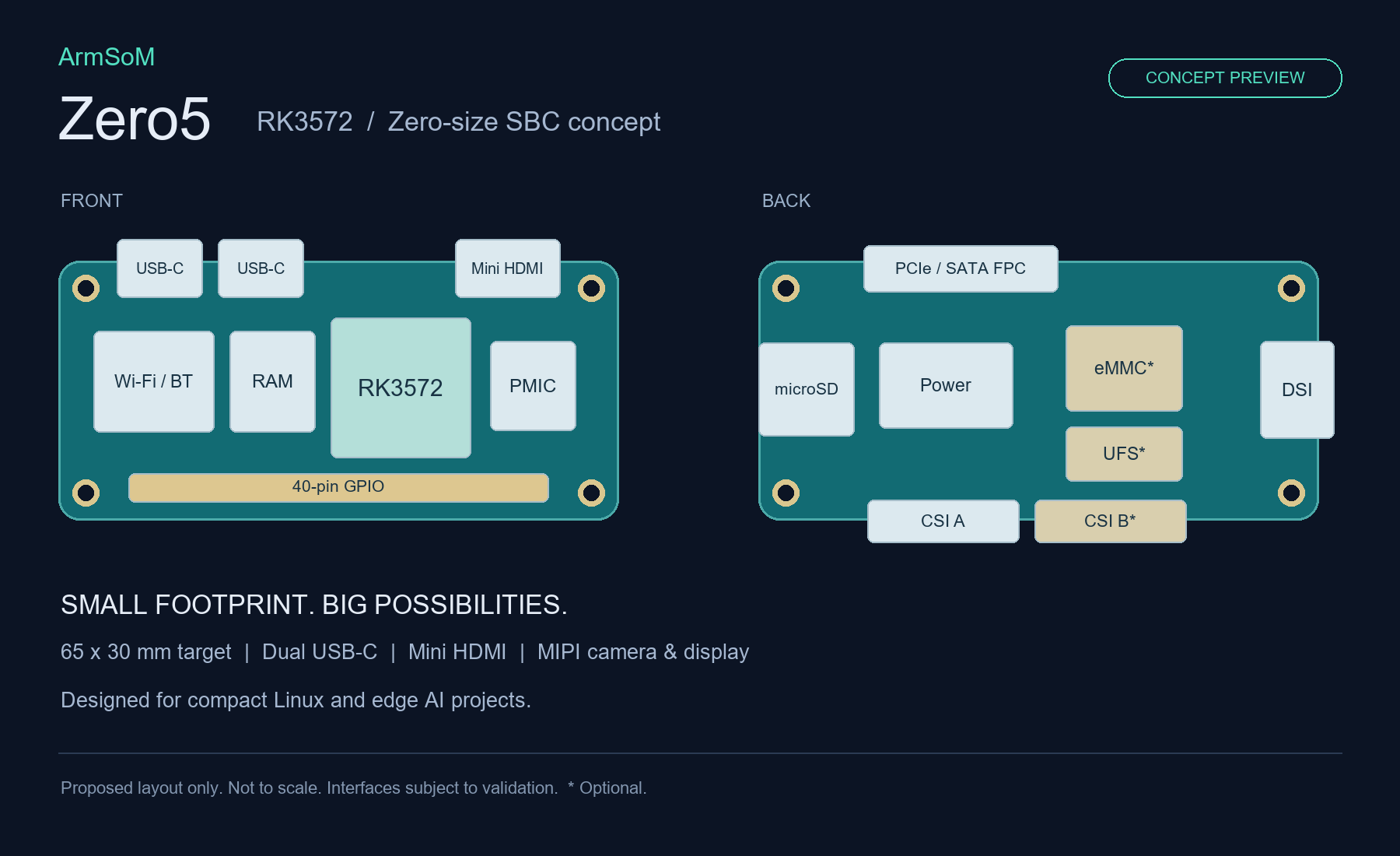
ArmSoM Zero5 concept preview. This is a proposed layout, not a photograph or a final specification. Items marked * are optional; interfaces remain subject to validation.
First, what is confirmed about Raspberry Pi Zero 3 W?
The name appears in Raspberry Pi's own Linux repository. The Zero 3 W device-tree file identifies the board as Raspberry Pi Zero 3 W and declares BCM2711 compatibility. Its addition is documented in Raspberry Pi's pull request #7711.
That is evidence of board support work. It is not a complete retail specification. At the review date, 17 November 2026, the official product catalog checked for this article did not list a Zero 3 W product page. We therefore leave its final memory, connector layout, price and availability unfilled.
This distinction matters when searching for alternatives. Comparing two imagined retail configurations would tell you little about whether either board can run your project. The useful comparison today is between the documented platform direction and the requirements you need to validate.
What ArmSoM is planning with Zero5
ArmSoM has announced plans for an RK3572-based Zero5. The concept drawing shows two USB-C positions, Mini HDMI, a 40-pin header and wireless connectivity on the front. The reverse shows proposed storage, camera and display connections. Items marked with an asterisk are optional, and the whole layout remains subject to validation.
These are design targets. They do not establish USB speed or power-delivery behavior, Raspberry Pi HAT compatibility, supported camera models, or simultaneous operation of the PCIe/SATA paths.
What we can compare today | ArmSoM Zero5 | Raspberry Pi Zero 3 W |
Evidence available | ArmSoM concept announcement and proposed layout | Device-tree support in Raspberry Pi's official Linux repository |
Processor reference | Rockchip RK3572, confirmed as the planned platform | BCM2711 compatibility declared in the device tree |
Abmessungen des Boards | 65 × 30 mm target; not a finalized mechanical drawing | Not established by the cited sources |
Final RAM, connectors and OS image | Pending final board specification and validation | Not established by a retail specification in the sources reviewed |
Price and delivery | To be announced | Not established by the sources reviewed |
Status comparison, not a performance benchmark. Sources: ArmSoM's Zero5 concept and Raspberry Pi's official repository/catalog linked above. Recheck product announcements before purchasing.
Why consider RK3572 for a small Linux board?
Room for application work alongside background services
RK3572 uses two Cortex-A73 and six Cortex-A53 CPU cores on an 8 nm process. For a compact device, this gives developers a platform to evaluate for application logic, network services and local processing. It does not establish a speed advantage over a finished Zero 3 W: that would require comparable boards, software and workloads. Rockchip's RK3572 announcement describes the processor.
A dedicated path for supported AI workloads
The RK3572 datasheet lists a 4 TOPS INT8 NPU rating with a sparsity footnote. A camera application, for example, could evaluate supported inference on the NPU while the CPU handles control logic and communications. Model conversion, operator support, memory requirements and accuracy still need testing. Rockchip's NPU specification is the reference for that rating.
Multimedia hardware for a compact device
RK3572 also provides a Mali-G310 GPU, hardware video processing and a 12-megapixel ISP. These blocks make a small visual terminal or camera-based device worth investigating. Whether Zero5 exposes the right sensor and display connections will depend on the released board and its drivers.
Memory capacity and thermal design matter here. Do not infer a Zero5 RAM configuration from the processor's supported maximum, or a sustained power figure from the fabrication process. Those are board-level choices and measurements that should accompany the final product information.
Three projects where Zero5 is worth evaluating
The following are proposed evaluation scenarios, not completed ArmSoM benchmarks.
A compact camera device with local inference
A device that detects a particular object and sends an event rather than a continuous stream needs capture, preprocessing, inference and communication. Zero5's planned RK3572 platform makes that workflow relevant. Begin by confirming the camera sensor, driver and model conversion path; then measure the full event latency under realistic lighting.
A small connected display or control terminal
A status display may need a browser or native UI, remote management and local storage within a narrow enclosure. Evaluate the actual panel connection, boot time, update method and thermal behavior. A target board footprint alone does not include plugs, cables or cooling.
A custom embedded prototype
If you expect to connect sensors or a small expansion board, prepare a pin-by-pin requirements list now. When the final Zero5 documentation becomes available, match voltage levels, bus assignments and software access to it. This is particularly important when carrying over hardware originally developed around a Raspberry Pi.
What would replacing a Raspberry Pi actually involve?
For a new project, “alternative” means another platform capable of doing the job. For an existing product, replacement also means keeping the application, peripherals and enclosure working. Evaluate those separately.
01Application & libraries
02Pins & peripherals
03Enclosure & power
04Workload validation
Four parts of a migration review. Passing one does not establish the others.
Software image and application dependencies
Plan to use a board-specific system image. A Raspberry Pi OS card contains platform-specific boot files and drivers; it should not be assumed to boot an RK3572 board. A portable Linux application may need only modest changes, while software tied to Raspberry Pi camera, GPIO or multimedia interfaces needs a closer review.
List those dependencies before estimating migration effort. Confirm the target kernel and libraries, rebuild what is necessary, and validate updates and recovery as well as normal operation.
GPIO, cameras and mechanical fit
A 40-pin connector does not prove that every signal, voltage, alternate function or overlay matches. Likewise, a similar camera ribbon connector does not establish sensor-driver compatibility. Check each peripheral against the final board documentation.
The enclosure needs its own check: mounting holes, component height, connector positions and cable clearance. Zero5's 65 × 30 mm target is useful for planning, but it is not a mechanical interchangeability promise.
Performance and power under the complete workload
Use the same application, input data and success criteria when comparing boards. Record boot reliability, response time, memory, temperature and total power with the real peripherals connected. Until that work exists, there is no supported percentage advantage to quote for Zero5 over Zero 3 W.
Häufig gestellte Fragen
Can ArmSoM Zero5 replace Raspberry Pi Zero 3 W?
Zero5 is a planned alternative to evaluate for compact Linux and edge-AI projects. It is not currently a validated drop-in replacement. The answer for a particular project depends on final board specifications, application portability, peripheral support and mechanical fit.
Is ArmSoM Zero5 available to buy?
The current ArmSoM material is a concept preview. Final configurations, price and shipping dates have not been established in the sources used here. Contact ArmSoM for the current development status before planning procurement.
Will Raspberry Pi HATs or camera modules work?
Compatibility has not been established for Zero5. Check electrical pin assignments, connector wiring, power requirements and drivers for each accessory. The concept's 40-pin header and camera connections are not universal compatibility guarantees.
Is Zero5 faster or cheaper than Zero 3 W?
No verified like-for-like benchmark or final price comparison is available in this preview. Zero5's planned processor gives useful capabilities to evaluate, but does not establish either claim.
What should I send ArmSoM to discuss a migration?
Include the application, current board, required peripherals, memory and storage needs, enclosure constraints, expected quantity and target schedule. Note any Raspberry Pi-specific libraries or accessories that the project depends on.
Discuss your Zero5 project
Send your requirements to sales@armsom.org to ask about development status and feasibility. If your schedule cannot wait for a planned product, discuss an existing ArmSoM platform and its current availability.
Raspberry Pi is a trademark of Raspberry Pi Ltd. This article is an independent ArmSoM product preview, not an endorsement by Raspberry Pi.
Sources and further reading
Reviewed 17 November 2026. Manufacturer specifications describe processor capabilities; board features and software must be checked against the selected revision.